Showing posts with label mail art. Show all posts

Wednesday, April 6, 2016

Letter writing month — April? February? Or how about whenever?

Earlier this year I got all jazzed about a letter writing challenge called a Month of Letters in February, promoted by Mary Robinette Kowal, encouraging people to send some correspondence every mailing day that month. She led a real cheerleading campaign via a Facebook page throughout the month, and has since taken an understandable break, with no new posts since March 1.


And I really got into it for a while, especially since Valentine's Day is a natural occasion for sending cards in the mail, right? I even got out some rubber stamps and washi tape I hadn't used in a long time, bought an assortment of postage stamps from USPS online,  embellished the envelopes, and had fun with it.

I did my mailing in clumps, skipping days and then sending several things at once. I didn't keep track of whether I achieved a one-to-one correspondence with mailing days, and in fact I kind of ran out of steam shortly after Valentine's Day. But I did mail a bunch of cards and ephemera, so I felt pretty good about that.

Then I came across something about April being National Letter Writing month, which the US Postal Service promoted last year, issuing some fun commemorative stamps while their collaborator, Scholastic, promoted a curriculum called It's a Delight to Write to encourage schools and families to teach letter writing.  
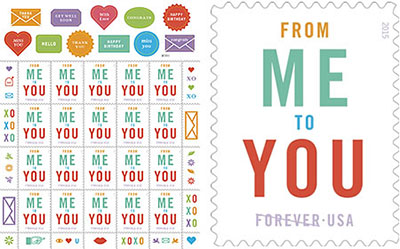


Last year's enthusiastic promotion, including a first-day-of-issue stamp kickoff, is followed this year by silence from the USPS, although plenty of others are taking up the cause, as a Google search reveals,  from those who just love to send and receive cards and letters in the mail to companies and makers wanting to sell you stuff for the purpose.

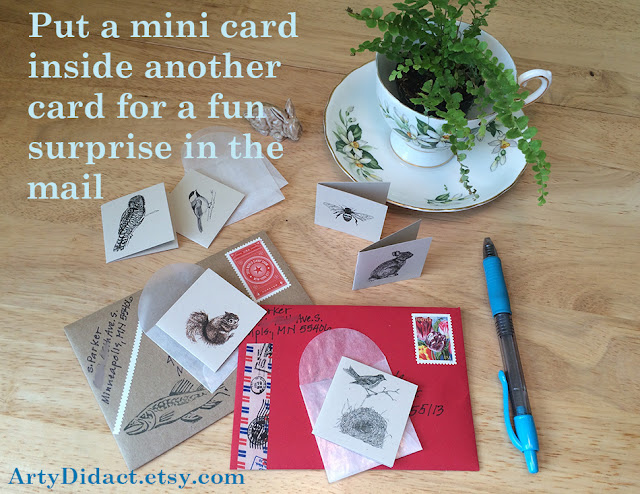
I confess I count myself among the latter. I am a card maker, so naturally I am eager to embrace any occasion for people to buy cards, whether they mail them or not. (The following shameless promotional photo clicks through to the card section of my Etsy shop, btw.)


But that whole mail-every-day-for-a-month thing just doesn't work out so well for me. Who really has the time and inclination for such an intense and sustained burst of postal activity?

So I've come up with my own alternative, which I have so far followed only sporadically, because it requires relearning a practice that our mothers and grandmothers followed as a matter of course. It has to do with birthdays and other occasions that once carried a certain expectation of postal correspondence.

For example, you could mail a birthday card with a personal note and maybe a little enclosure, if you are so inclined, on people's birthdays, instead of offering up the Facebook greeting that everyone knows you were prompted to do anyway. What a quaint notion, right?

You'd have to plan ahead for that, rather than rely on the Facebook prompt, and allow for the sad reality that US first class mail now takes 3 to 5 days. I've started by making a list of the birthdays I know, adding them to my calendar and setting up an alert for 5 days before.  

I've also found that I can view all the upcoming birthdays on Facebook, and add to my calendar the ones I'd like to acknowledge postally. Here's how: From your Facebook home page, click on "Events," then look in the upper right where it says "Birthdays this week," then click on "See all," and there you will find them all laid out before you. Add what you wish to your calendar to help you remember to mail a card. Nifty, huh?

So far I've mailed one birthday card. Hey, it's a start!

Yes, it's another sneaky attempt to get you to look at a card in my shop.

Then there are the once-obligatory thank-you notes. For those aspiring career-hopefuls, it's an excellent follow-up to a job interview, thanking the interviewers for their time and reiterating what you really like about that company you'd like to work for. 

But why not also send one to the friend you had lunch with? A little note sent through the mail, saying how nice it was to have lunch and catch up, and how you're looking forward to the next get-together. It gives you the opportunity to pause and reflect on how much you value the other person's friendship, and actually commit a few words to paper about it. 

My husband's friend Seth sends him a card in the mail on random occasions — a clipping he came across that he thinks Craig would like, or a photo he took a long time ago that he made into a card. He also sends photos of the two of them after they've had lunch together. These little notes are brief and unexpected and always a pleasure. 

Recent cards from Seth

There is something kind of luxurious — although it really takes little time and effort; and the cost is minimal — about committing a few friendly words to paper, putting it in an envelope and adding a stamp, and then taking a walk to the nearest mailbox.

I'm not going to challenge you to commit to mailing something every day for a month, or once a month, or for every birthday of everyone you know. Just try it once, and see if it doesn't give you a certain satisfaction. You may even want to do it again. Sometime. Randomly. Without obligation. A moment of slowing down, for both you and the recipient.


Tuesday, February 15, 2011

On Saints and Birds and the Commercialization of Holidays such as Valentine's Day

In today's Minneapolis Star Tribune, artist Larry Hanson illustrates a quote about St. Valentine, from Episcopal priest Howard B. Harper, which says, "Poor old Valentine, a third-century priest, who was clubbed and beheaded on February 14th, in the year 270, would certainly be surprised to find himself a lovers' saint." And on the always-entertaining blog of Cul-de-Sac comic creator Richard Thompson on Friday, we have "A History of Valentine's Day Cards, Again," with the assertion that "every word of it is true," in which he illustrates the oft-repeated myths that (a) Valentine's Day is really just a re-creation of the Roman fertility festival of Lupercalia, and that (b) St. Valentine  was arrested and eventually martyred for performing illegal marriages (banned during the reign of the emperor Claudius because it hampered his military recruiting efforts), and that he corresponded with his jail-keeper's daughter, signing the letters, "Your Valentine." (The image at right is from one of many sites that purports to relate the "true" story of St. Valentine.)

I love both Larry Hanson's regular "You Don't Say" illustrated quote and Richard Thompson's Cul de Sac comic. But while both are claiming to be presenting some truth about Valentine's Day that is little known, they are really only repeating what others have said, without question.

We all do that, of course, me included. When we learn something that sounds new to us that also happens to confirm our worldview, we are eager to embrace this new "truth" and even disseminate it to enlighten our friends and acquaintances. And while this sort of repetition of perceived fact without investigation has been going on for ages before the Internet was invented, the easy access to everyone's learned opinion makes the Internet an especially prodigious rumor mill. Which is sometimes fun, but also has the effect of helping myths to spread even more quickly and widely than they did when we got most of our information from the much slower but often just as misinformed print media of various kinds.

As Charlotte said to Wilbur in E.B. White's classic children's story, Charlotte's Web, "People will believe anything they read in print." Had he written the book today, surely he would have happily punned, "People will believe anything they read on the web."

For some reason I can't exactly explain, I have been obsessively curious about the history of holidays of late. I read The Battle for Christmas by Stephen Nissenbaum earlier this winter, which led me to read part of The Invention of Tradition, a collection of scholarly articles edited by Eric Hobsbawm and Terence Ranger. Soon a kind of intellectual domino effect was triggered in my mind, and I found myself hunting down articles in  scholarly journals, which I found I could access online after logging in to the Hennepin County Library website and following the research page to the databases link. It was an exhilarating discovery: A person can do real research online instead of relying on Google, which tends to lead you into an endless loop of sources quoting each other and often all leading back eventually to Wikipedia.

Without delving any deeper into explaining the processes of my particular strain of geekiness, and with the advisory that I am still researching this and looking forward to putting together a zine or something on the topic of various holidays (And dubious saints! Maybe trading cards!), I thought I ought to take a moment to share some of what I've learned so far. I'll apologize for not citing more sources at this time (I've dropped in a few links, even so), but it's nearly midnight and I thought I ought to post something about Valentine's Day while the topic is still timely.

Herewith, a few things I've learned about Valentine's Day, which probably don't confirm anybody's worldview, unless you are an avowed skeptic of everything you've been told so far:

Lupercalia, which was celebrated by the Romans on Feb. 15 or thereabouts, was a patriotic holiday, a kind of founders' day, if you will. The etymological root of Lupercalia is lupus, Latin for wolf, referring to the wolf mother who raised Romulus and Remus, the mythical founders of Rome. If Valentine's Day were a reinvention of Lupercalia, surely we'd be setting off fireworks and waving Roman flags, not eating chocolates and sending cute love-themed greetings.

Valentine was a popular name amongst Romans. The name shares the same root as the word valor. It meant a brave, strong person. Who wouldn't want a name like that? Of course there were lots of people named Valentine. And of course some of them would have been Christians and some of them priests, and it's entirely possible that some of them would have been martyred for their faith. Persecuting Christians (and Jews, btw) was what many Roman emperors did. (But not all of them, and it appears unlikely that it was a predilection of the emperor Claudius who was in charge during the years in question—there also appears to be no record of any marriage ban during his short reign, from 268 to 270 A.D.). The early martyrologies had, in fact, identified at least two saints named Valentine who were both said to have been martyred on Feb. 14, in 268 or 269 or 270 A.D. But in the mid-20th century, the Catholic church concluded that the evidence about Saint Valentine, whether there were two or just one of him, was dubious enough to remove his feast day from any official observance. In other words, the church isn't sure of any historical facts about the saint.

The first recorded association that scholars have been able to find of Valentine's day with love and romance—and birds, incidentally—was when, in about 1383, Chaucer published his fanciful story poem The Parlement of Fowls, in which he describes an imaginary gathering of birds choosing their mates. Scholars think that he may have been connecting certain phenological observations—birds begin singing again around mid-February (I heard some especially bubbly house finches just yesterday), and the earliest signs of spring begin to manifest about this time—with the saint's day that falls at a convenient point in the natural year.

This association of Saint Valentine's feast day with courtship really caught on amongst the aristocracy in the 15th century, because it fit in so handily with the courtly love traditions already established there, and was a welcome diversion in late winter, before things got really busy in the spring (this was still an agrarian economy, remember).

The peasant classes appreciated a little late winter fun, too, and young unmarried people celebrated the day by pairing up as couples and going carousing in the taverns in groups. It appears that this folk custom was more about partying than about getting serious about romance, however. In a preindustrial agrarian economy, there's a certain amount of downtime that would be coming to an end real soon about this time of year, so why not party while you can?

Valentine's Day was largely unheard of in America until about the 1840s, right around the time people started getting into celebrating Christmas (coincidence?). A great deal of marketing by American businesses had something to do with it. What? You thought the crass commercialization of holidays was a late-20th century invention? It wasn't all crass, though, people had fun with it, and many of the 19th-century valentine greetings were quite clever and often humorous. And from these early beginnings in America, children were included in the exchange—it wasn't just about adult romantic love, but also about parents' affection for their children, and children's friendships, too.

The Hallmark company has a collection of historic American valentines at its headquarters in Kansas City, as does the Hennepin History Museum. (The image above is from Indiana University.) I like to think of this fanciful correspondence as early examples of mail art, but that might just be me seeking to confirm my worldview. The mailing of valentines peaked around 1850, at which time the post offices were swamped with seasonal mail, much like they are now at Christmastime.

It appears that ever since Chaucer's time, the holiday has taken on many meanings, from birds singing and pairing up, to courtly romance and poetry, to more lighthearted gestures of love and affection. I suppose people over the years have made of it what they like, according to their preferences and, dare I say, worldviews. And isn't that really the best sort of holiday?

I hope you had a happy Valentine's Day, however you chose to mark the day.