Showing posts with label minneapolis observer. Show all posts

Wednesday, May 13, 2015

The Beginnings of the Useful Calendar. But, wait: Aren't All Calendars "Useful"?

I was getting ready to do a little show-and-tell about some design innovations I'm working on for the 2016 edition of the Useful Calendar, when it occurred to me that I should probably first give you a little background on this annual project of mine—the story behind it, and why I call it the "Useful Calendar."  It has changed quite a lot since I began it 10 years ago. 


The first Useful Calendar in 2006, and a few other early editions, on letter-size card stock (cartridge paper)

Introducing the Useful Calendar

I've been compiling the Useful Calendar since 2006, when it was a free promotional item for readers of the Minneapolis Observer, a monthly newspaper my husband and I used to publish. I had seen promotional calendars from other businesses, and felt that they weren't informative enough or convenient enough in format to be truly useful.

I included dates that I thought would affect planning, and put it all on one page, so that a person could glance at this calendar and quickly see not only the date of Easter, or day of the week for the 4th of July, but also major local events that can obstruct traffic and parking, and cultural events that a considerate person might want to know about so they don't plan a community potluck luncheon in the middle of Ramadan, for example.

At the same time, I did not want to clutter it with what I considered to be frivolous or promotional events, even those that promote worthy causes. So, no Coffee Day or cancer awareness, or even Black History Month. Because I wanted it to fit on a page and still be a readable font size.

And that's why I called it the Useful Calendar.


How a Calendar Led to an Etsy Shop 

Soon after I created the first Useful Calendar, the Observer went out of business. We then launched a much smaller publication called MOQ (Minneapolis Observer Quarterly), a literary zine about "exploring the bucolic city," and I continued to create the Useful Calendar under this new moniker and give it away to subscribers and others to promote the publication. Really, though, I made it because I found the calendar useful and I hoped others would too. It was too much work to create it only for myself.

In 2009, I also made it into a set of cards, because I really liked the idea of having a smaller, pocket-sized version of the calendar that I could keep in my purse. I made them the size of Artists' Trading Cards (ATCs, 2-1/2 x 3-1/2 inches), because I was into those at the time. I then designed and made a paper pocket to hold it, and laminated it with packing tape for durability. 


An assortment of pockets with the 2014 calendar cards
This innovation was, in truth, also all about me, and what I found useful and pleasing. But I truly hoped that others would think so, too.

So I launched an Etsy shop, which I called Arty Didact, reflecting the way I like to combine art and information (i.e., didactic art), the calendar being a primary example of that. I have steadily added many different products to my shop, to the point of it becoming rather too eclectic, but that's another story.


The 2011 version introduced the Chinese zodiac animal as a theme, and included a few planetary notes, plus made-up names for the full moon dates, which are circled.

When working on the 2011 edition, I was pondering what to illustrate the calendar with, when I hit upon the idea of using the Chinese zodiac animal. It was the year of the rabbit, and the drawing I did for that year's calendar soon became the iconic image for my Etsy shop.  

Just as selling the calendars led me to open an Etsy shop,  opening an Etsy shop changed who I was making the calendars for, which led to further changes in the focus and format.

Read the rest of the story here.


Tuesday, September 10, 2013

Linear geometry


Our backyard and the alley behind our house are criss-crossed with power lines, like buntings missing their flags, connecting poles to houses and other poles, linking our house to other houses and garages and the new apartment building on the corner and across streets and more alleys, sometimes departing from their alley routes and running alongside residential streets, where too-tall trees have been pruned ungracefully to accommodate their relentless progress, which eventually connect the houses on my block to a cluster of wires and structures looking like something out of a futuristic model city surrounded by a tall chain link fence on Hiawatha Avenue.


From there, bundles of wires and cables travel high above Hiawatha, which is one of our major thoroughfares known also as Highway 55, past grain elevators still in use and new construction in process where other grain elevators used to be, alongside railroad tracks that are only used for a few weeks in the spring and fall, stretching to downtown and then on out of the city to the nuclear power plant in Monticello, as well as a wind farm somewhere on a prairie in the western part of the state, although that last bit may be only wishful thinking on my part.

We sometimes sit on our backyard patio on summer evenings looking east, watching clouds turn pink in the evening beyond those criss-crossing lines.

My drawing of the hapless power pole canister, before it exploded
At our previous home, there was a large rusty-looking tin can attached to the power pole, with wires and coils and pipes sticking out from it here and there. It often became a focal point of our evening conversations over a bottle of wine as we speculated about its contents and function. Sometimes we imagined it to be a Rube Goldberg device powered by squirrels. Sometimes we wondered if it could be a nuclear reactor in miniature.

Then one July day the thing blew itself up with a loud POP!, allowing nothing more than a curlicue of smoke to escape, leaving it with a jaunty-looking topknot of twisted, blackened wires. It was soon replaced with a shiny new cylinder, with no interruption in power to our home in the interim. This did nothing to diminish its mystery in our minds.

I like the power lines and the poles with their mysterious numbers and other markings. I appreciate their linear geometry, the contrast of these structures and lines with the soft amorphous forms of the clouds and the mottled green expanse of the maple tree that towers over our neighbor's backyard and the alley; the way the birds perch on them as though that is the very reason they were erected.

They provide a visual reminder of our connection to points near and far, the relationship of the built to the natural landscape. Even as we sit in our own backyard.


Saturday, August 31, 2013

Night sounds of late summer

The crickets are back.

For most of the summer, I have not been hearing crickets in the night and I wondered why. I think of their persistent chirping as one of the sounds of summer nights.

Now, after about two weeks of very hot weather, I'm hearing cicadas in the afternoon and crickets after dark. Perhaps our long cool stretch from mid July to late August kept the crickets quiet?

When I tested this question via a Google search, I found several sites that offer a formula for calculating the temperature by counting the number of cricket chirps in a period of time — such as this Library of Congress page — and a few others stating that cool temperatures do indeed suppress chirping.

But what I had forgotten is that it is typical for crickets to start chirping in mid August. That's simply how long it takes for the insects to mature to the chirping stage, which is when they are ready to mate.

One rather poignant blogger describes it as "That sweet, sad sound of summer's end."

And after a long stretch of sweltering weather, I'm pleased that I can finally open my windows and hear the crickets.


Tuesday, April 23, 2013

Snow — just another spring ephemeral


A note: I wrote this for the March 8, 2004, edition of the late Minneapolis Observer, a short-lived newspaper that my husband and I used to publish. It's topicality is apropos this spring, while at the same time revealing how unusual it is even here in Minnesota to get this much snow this late in the season. Still, it's a reminder: it's all ephemeral, nonetheless. —Sharon

On Thursday, my friend Sandra was positively gleeful at the prospect of 6 inches or more of snow. She is an avid winter athlete and once cross-country skied on Theodore Wirth golf course after a particularly late April snowfall, much to the chagrin of the groundskeepers.

By March, my attitude toward winter is one of indifference. After 47 winters, I am no longer impatient for spring to begin—I know it will come soon enough. And I am no longer dismayed by late-season snowfalls, even after a long thaw has dangled the promise of an early spring only to snatch it away again. I know it won’t last.

I think of this snow as the first of the spring ephemerals. In gardening, we usually think of ephemerals as those early bloomers that disappear, leaves and all, once summer is underway: the bulbs we plant in fall; the woodland wildflowers that bloom before the trees leaf out, then retreat under the ground again.

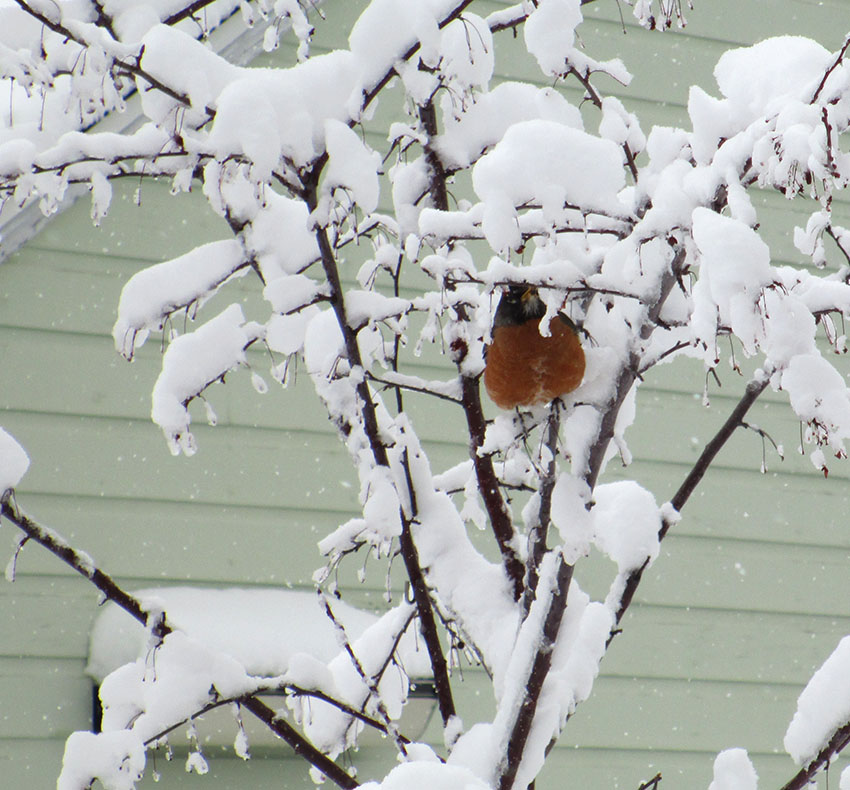
But snow is one of these too. Consider how profoundly it transforms the landscape in winter—the mounds that turn our sidewalks into valleys, the mountains in the corners of parking lots, the bright white clingy coat that forces the arborvitae to bow down in homage to the forces of nature, the snow “flowers” on mugho pines. And then it all melts away. Vanishes. A re-creation of the great ice age, in mere months, and then nothing. I know I’m odd, but the whole transformation from winter’s snow-sculpted landscape to flat, muddy early spring—even before the greening of spring at its peak—fascinates me. Every year.

So as I went about my business on Friday while clumps of wet snow dropped heavily from the trees as frequently as the big sticky flakes fell from the sky, I was glad I didn’t have to look at the dirty grey-black patches of ice that had been everywhere and will be exposed again soon. We can put off cleaning the yard a little longer. I just discovered one of my boots has a leak but my wet foot doesn’t make me miserable because I’m distracted by the unfolding drama. I look around and marvel at a fleeting winter wonderland that soon will be no more.