Showing posts with label butterflies. Show all posts

Wednesday, November 14, 2018

Butterflies for the Useful Calendar -- some works in progress

I've been painting watercolor illustrations of butterflies for the 2019 Useful Calendar, and sharing pictures of some of them on my Facebook page. But as I always have something  to say about my artworks in progress (the back story, you could say), it occurred to me that this blog is better suited for that.


At the coffee shop, on a day suitable for bike riding, to proofread the calendar in progress.
Even though I settled on butterflies for my calendar illustrations several months ago, I'm a terrible procrastinator, so I started actually doing them about a month ago. Each one takes four to six hours to complete, so I really can't do more than one in a day; and I prefer to allow two or three days for the whole process: two days for sketches and studies and painting, then one day to set it aside before taking a fresh look and adding any finishing touches.

I've managed to condense the process into one day by making it my primary occupation (it's very difficult for me to make anything my primary occupation), and by being rather more disciplined about it than is my nature. It being cold and snowy and getting dark early does help, because I don't feel much temptation to get out on my bike in the afternoon these days.


A slightly later version of the calendar, with a few of the butterflies in place.
But a thaw is coming, and I have bulbs and roots (of butterfly-friendly native plants) still to plant, so I will have to muster a bit of extra resolve to finish the last two (yes, two left!) and get the calendar done and ready to go by the end of this weekend (which I am determined to do). Then I will make it available in my Etsy shop and, hopefully, at a couple of local consignment shops.

Now, here are the first few illustrations, with a bit of context and an explanation for why that butterfly for this month. I'll share more of them over the next week or so. 


Monarchs wintering on eucalyptus 
I wanted each month's butterfly to relate somehow to its month, so, being a Minnesotan, I wondered what I should do with the winter months. That led me to think about monarchs migrating. It's widely known that our monarchs fly to Mexico for the winter, but I learned a couple of years ago that those west of the Rockies winter in coastal California, in eucalyptus groves. So my January butterflies are monarchs on eucalyptus. 

I like to think these are in Pacific Grove, a charming city adjacent to Monterey. We stayed in Pacific Grove when our son graduated from the Defense Language Institute a couple of years ago, at a motel called the Butterfly Grove Inn, so named because it is next to a butterfly sanctuary. It was June, so there were no monarchs at the time, but it was a new discovery for me that monarchs wintered there. We hope to go back some winter.

Pacific Grove has a very nice natural history museum, too. I highly recommend it.


A pig and tiger swallowtails enjoying some mud

The Year of the Pig begins February 5, 2019, and I have made it a tradition to feature the lunar new year animal in my calendars, so I contemplated how to combine the two. What do they have in common? Well, as it happens: an affinity for mud! Several species of butterflies, including the tiger swallowtails depicted here, will gather in mud puddles to extract vital minerals from the wet soil, a practice known as puddling.


Question mark butterfly, left (November); zebra longwing, right (December)
I've not been painting them in any particular order, and since I am showing you winter butterflies (well, the swallowtails aren't a winter butterfly, I just put them in February because they "go" with the pig), here are some more of those.

The December butterfly is a zebra longwing (right), which flies year round in the far south including Florida, southern Texas, Mexico and Central America. It is the state butterfly of Florida, and one of its nectar plants is the firebush, on which I placed it to add a little splash of color.  

The question mark, shown perched head down on a spruce branch, could still be active in November in a milder region than Minnesota. Some of them will migrate to southern states, and some will hibernate in the north. Hibernating butterflies tuck themselves into a crevice in a tree or structure, or crawl into the midst of a brush pile, and spend the winter in a dormant state.  This nature museum in Chicago offers a nice succinct explanation of butterfly hibernation.

Butterflies may hibernate at any stage in their life cycle, depending on species. Those that hibernate as adults emerge fairly early in the spring, likely before there are any flowers to provide nectar. Luckily, flower nectar is not their preferred food; rather, they feed on tree sap, rotting fruit, and animal waste. 

That includes the mourning cloak, my March butterfly and another one that hibernates in adult form. I have seen these flying when there is still some snow on the ground — they'll even land on a snow pile to sip a little moisture, and probably get some nutrients from the dirt that's mixed in.


Hibernating butterflies, in whatever life stage they do it, need shelter in the form of leaf litter, brush piles and wood piles, as well as mature trees with gaps and crevices they can crawl into. You can help them out by not tidying up your yard too much in the fall.


Wednesday, April 18, 2018

Art, inspiration, pigs, and butterflies

I've been pondering and playing around with design ideas and a theme for the next edition of the Useful Calendar, which I start working on shortly after the current year begins. It comes in two formats: a set of cards for desk or purse, and a year-at-a-glance poster. I focus on the cards first, making the poster only after all refinements and corrections are completed on the cards to save duplicated effort.

Most years I take the Lunar New Year animal as my theme, and for 2018, which is Year of the Dog, I even modified the layout to allow more room for illustrations—because dogs, right?


For most years prior to this I did one illustration for the cover card and put more text on the individual months, as in 2017, the Year of the Rooster:


But in 2016, feeling uninspired by the Year of the Monkey, I decided to change the theme to bees. Specifically, 12 wild (native) bees from around the world. But I didn't have any ideas about how to make more room for the illustrations, so the cards were still quite text heavy and the bees were kind of small—the original watercolors are about 4 x 6 inches; the calendar cards are 2.75" by 4.25".


I did take the bee illustrations and the research I did about them and make it into a zine, which is available in my Etsy shop, and locally at the Minnesota Center for Book Arts.

Which brings us to 2019—Year of the Pig. I wanted to continue with the new layout allowing more room for art, which means coming up with 12 unique illustrations of pigs. I  had started to gather some ideas, trivia, and inspiration about pigs to inform the artwork, including looking for folktales about pigs and bookmarking sites with curious pig trivia, like this one about Pigcasso, a painting pig in South Africa, and another about a spot in the Bahamas called Pig Beach.

But, as fun as those discoveries might be, none of it was inspiring me to start doing illustrations of pigs. I mean, even with the added room for artwork, it's still got to be quite small, and a picture of a swimming or painting pig kind of needs some context, and I still needed to come up with 10 more unique ways to depict pigs. It just wasn't working for me.

So I asked myself, what would I like to illustrate the 2019 calendar with? 

When I am pondering ideas I tend to stare out the window. And when I look out the window I see a foot of snow in the middle of April. So, naturally, I think about my garden, and summer ... and butterflies.

Question mark butterfly, perched on the wood frame of my kitchen garden last summer.

And it just so happens that I've already got a lot of butterfly photos that I've taken in my own garden.

A slightly tattered tiger swallowtail visiting hydrangea in an alley near Minnehaha Falls park
 I'll also do illustrations by referencing a variety of photos on the web to put together a generic composite image, such as for this watercolor of a nonspecific azure butterfly:


So now that I've settled on a theme, the next step is choosing colors (one of them will certainly be butterfly blue) and fonts. See my next post about my design inspirations and ideas here.

Some of my illustrations end up on note cards, book plates, and stickers, which you can see in my Etsy shop, also called Sharon's Compendium.


Tuesday, March 14, 2017

A Shamrock by Any Other Name ...

Last year's clover, in a sweet little vase from Catherine Reece pottery.
Perhaps because St. Patrick's Day occurs so close to the vernal equinox, I get a little preoccupied with shamrocks and clovers and other green growing things. 

It's the month when many Minnesota gardeners are getting ready to start seeds indoors, and although I feel the same urge, I haven't done much seed starting for quite a few years. I did plant some cilantro seeds in a peat pot a couple of days ago (they're sitting in a south window, waiting to germinate), and that may be the extent of it for me this year.


Some years I have started seeds of white clover, Trifolium repens, at the beginning of February in order to have a pot of them in time for St. Patrick's Day. I've even written about it here and here.


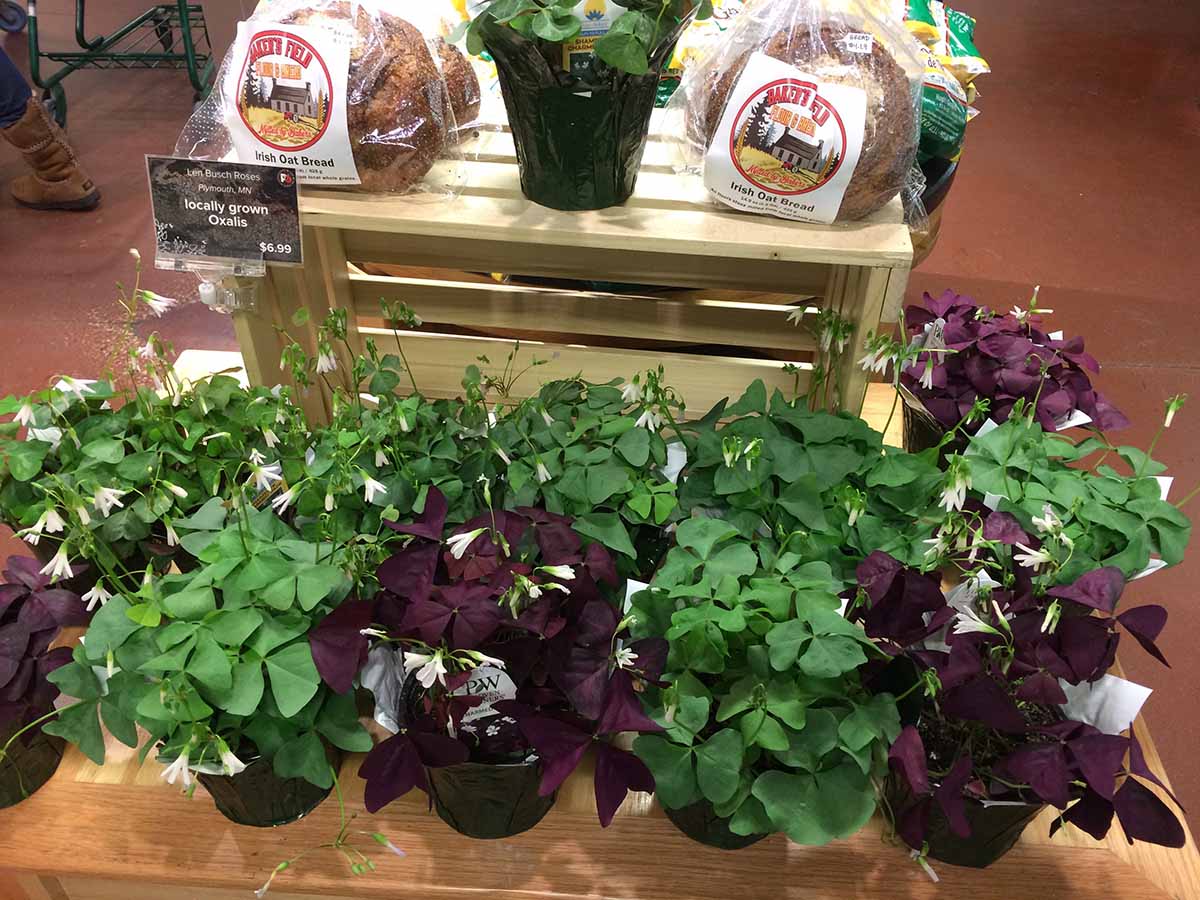
These are not the "shamrocks" you see in the grocery stores about now. That plant is a type of oxalis, aka sorrel, that does not grow wild in Ireland or any other part of the northern hemisphere. But it makes a much nicer houseplant than do the clovers, so I guess the greenhouse growers figured, why not?


Oxalis at Seward Co-op today, in a display with Irish oat bread. Note they're not calling them shamrocks.

The plant identified as a shamrock by a plurality of the Irish (46%  in a 1988 survey) is lesser trefoil, aka hop clover, aka several other common names, aka Trifolium dubium, which is a bit smaller than white clover and has yellow blossoms. Although not as well known as white clover, it is, apparently, about as widespread. Native to Europe and Central Asia, it's been introduced and naturalized in North America, Africa, and New Zealand. 

Phinney the Galway cat (at least, that's where his name comes from) with my watercolor illustration of T. dubium, one of the Irish shamrocks. (Phinney's much more interested in the pencil than the art.)

Now that I've been studying this plant a little, I'm pretty sure I've seen it in many of the grassy strips between the sidewalk and street (which we call the boulevard here in Minneapolis, an apparent idiosyncrasy of my city). It's considered invasive in many areas, but not always because it is a problem for native species; more often, it is said to "invade" lawns. But since lawns aren't exactly natural ecosystems, that's not really saying much. 

Some photos of T. dubium show the plant with much rounder slightly bluish leaves, but that could be a case of mistaken identity, since there are a few look-alike species, as this site explains. 

The reason I've tended to favor white clover (T. repens) as the shamrock, even though it was the runner-up to lesser trefoil in the fore-mentioned survey (at 35%), is because the seeds are easy to come by; and that's because it used to be considered a desirable addition to lawn grass seed mixtures; and that's because it's a legume, as is  T. dubium, and so "fixes" atmospheric nitrogen, which means that it makes it available for other plants to take it up, which makes the grass healthier and greener.


Now it's most often considered a weed by those who prefer a manicured grass-only lawn, an aesthetic that emerged after WWII and the introduction of broadleaf weed-killers, according to historian Virginia Scott Jenkins in her book, The Lawn: A History of an American Obsession (published by Smithsonian Books in 1994). 

In other words, it became a weed once there was an herbicide that could kill it. In fact, the target plants were plantain and dandelions, with clover being an innocent bystander, but in order to sell the chemicals to the public, the makers had to convince them that clovers were weeds too.  

Except now it's finding its way back into the good graces of those who prefer a low-maintenance, diverse lawn that's much prettier than a boring grass carpet. Clover is also very much appreciated by butterflies and bees (including several non-stinging wild bees), mammals* (yes, that includes rabbits, you bunny haters), and birds (who eat the seeds).

My recently completed watercolor of T. repens

Clovers are also edible to humans, offering both protein and carbohydrates. In fact, according to the comprehensive history by Charles Nelson in his book, Shamrock (Boethius Press, 1991), the earliest observations about shamrocks in Ireland, reported by literate visitors, were that the Irish ate them.

And that, not anything St. Patrick did with them (if he did), is the most likely reason shamrocks have become the emblem of Ireland.


* Fun fact—Other wild animals that consume white clover:

Leaves and flowers are eaten by grizzly bears, moose, mules, deer, blue grouse and the white-footed vole.

Seeds are eaten by these birds: northern bobwhite, bufflehead, American coot, several different grouse, the horned lark, mallard, gray partridge, greater prairie chicken, willow ptarmigan, American pintail, California quail, and American robin.

Many butterflies use them as caterpillar nurseries, including the eastern-tailed blue and several sulfurs and skippers. Still more butterflies visit clover blossoms for the nectar.

 (From Encyclopedia of Life)


SaveSave

Wednesday, August 3, 2011

Baby Blues

I was out in the backyard today when tiny pale blue wings fluttered by. I had my camera handy, so I grabbed it and took some shots as the lilliputian butterfly flitted about among the white clover in my lawn. I know there are a few types of blue butterflies in Minnesota, all of them with a wingspan no bigger than about an inch, and so easy to miss unless you're keyed in to spotting pretty little things. Maybe I'm even a little obsessed with them; I think they're adorable and will make a point of planting their favorite flowers to encourage them to stick around.

All the blues are small; in fact, the tiniest butterfly in the world is the pygmy blue, native to the American Southwest, according to Stokes Butterfly Book. Its wingspan is less than a half inch.

The upper side of the wings is the blue part, a pale almost lavender color that you only glimpse as it flutters about.  This guy would not spread his wings when he perched on the clover, so all I could get is a shot of the underside of the folded wings, which is more silver, with distinctive spots. But that's how you identify them, so he was actually being helpful. See the hint of orange in the two splotchy spots near the base of the wings (you should be able to click on the second photo to get a larger view; it doesn't look as orange in these photos as it did in real life), and the two rows of black spots with white margins, and (this is really hard to spot) the really tiny threadlike "tail" by the not-quite-orange spots? All those markings identify this guy as a male Eastern tailed blue. (And you thought I was being sexist, didn't you?) The females don't have the orange spots and aren't as blue.

It won't be hard to provide both nectar and larval plants for these and the other blues—silvery blue and spring and summer azures are also found in Minnesota (and far beyond, of course). They all like legumes, such as clover, vetch and alfalfa, for both caterpillar food and nectar. The silvery blue also likes lupine and dandelions, and the spring azure goes for dogwood, wild cherry, and meadowsweet. (I believe that's the wild spirea, S. alba, although some sites that came up on a quick search say it's filipendula; that's why I often find common plant names a bit annoying, even if they are more poetic than their scientific counterparts).

Eastern tailed blues also like to take nectar from goldenrod, asters, fleabane, white sweetclover (that's our native clover) as well as the Dutch white clover often growing in lawns and pictured here. Did you notice how many of those plants are common weeds that many people work very hard to get rid of?

It's good timing on the butterfly's part, since I am in the process of planning the gardens; a delicate reminder to remember all the butterflies that may find their way to my yard, and not just the big showy ones (I already have a few species of native liatris planted to please the monarchs).

Monday, May 16, 2011

Sweet Violets

I've been seeing lots of violets lately, in lawns and gardens and the crevices of sidewalks. They appeared about the same time as the dandelions, right after we had a hot day followed by lots of rain. I have no understanding, and certainly no sympathy, for those who consider them such a menace that they'll part with their hard-earned money to have some chemical company come and poison their lawn just to get rid of them.

Amongst the various definitions of insanity,  I'd suggest that poisoning your lawn and, subsequently the birds and other innocent creatures who visit it, in order to destroy a harmless little flower growing amongst the otherwise boring blades of grass really ought to be one of the top ten.

Common sweet violets (Viola odorata) and their cultivated cousins the pansies (Viola tricolor), and also all members of the viola family, are not only pretty, but also tasty mixed in a salad or decorating a cake. They're mildly sweet and, in truth, offer more in the way of edible decor than flavor. One of our neighborhood bistros, Al Vento, has grown pansies in the planter boxes surrounding their patio, and last spring, I remember the waiter snipping a few for the chef, who used them as a garnish with dessert.

Of course, we're not the only species that can enjoy violas as food. Rabbits will happily munch on them rather than on your garden plants, if the supply in your lawn is plentiful. Fritillary butterflies prefer them as larval plants, and recently emerged bumblebee queens appreciate the nectar after their long winter nap—and anything you can do to get bumblebees to stick around will increase the yields in your garden, especially on the tomato plants, which bumblebees pollinate better than any other insect.

Despite their delicate appearance, violets are tough and sneaky little flowers. Hence, all the efforts to eradicate them from lawns eventually fail. They spread by underground runners as well as by seed, which is why they tend to colonize a given area once they get started there. And when they are ready to go to seed, they nod and tuck their little inconspicuous seedheads out of site and near the ground, so regular lawn mowing doesn't even affect them.

They have some medicinal uses, too, though I've never tried to use them in this way. According to this site, the ancient Greeks used them to "moderate anger" and strengthen the heart, and one of the common names for both violets and pansies in old England is Heart's Ease. A delicious bit of irony, when you think of the people so irritated by them that they'll do anything to kill them.