Showing posts with label bumblebees. Show all posts

Monday, August 10, 2020

With apologies to the bees and goldfinches


I'm not the most fastidious gardener as a general rule, and when a relentless heat wave like we experienced for nearly all of July comes along, I'm even worse. There were a few days at the beginning of the month when I got out in the garden early in the morning (like, around 6 a.m.) intent on making at least the most public part of my front garden presentable, and I did accomplish that much anyway. But for the rest of the month I looked out through my windows at the rampant weeds and said, "mmmm ... maybe tomorrow."

I favor a not-too-tidy cottage garden look, with an emphasis on native plants balanced with and contained by a few old-fashioned staples, like peonies, disease-resistant roses, and a boxwood hedge. 

I planned the garden with birds, bees and butterflies in mind, and placed a bird feeder in the front yard where we could see it from our dining room windows. Knowing the spilled seed would mean a lot of weeds (mostly sunflowers), I tried to design it so that the messiest areas would be screened somewhat from the street view: there's a serviceberry (Amalanchier laevis) and then a row of boxwood between the feeding area and the front edge, with a "terraced" flower garden next to the sidewalk (shown here in August when it's mainly just the mums blooming).

("Terraced" is in quotes because the front edge of the yard is set off by a low retaining wall we made from chunks of concrete after taking up a sidewalk in the back. A second row of sidewalk chunks is arranged a few feet back from that, in front of the boxwood. Hence, it's a "terrace.")

Respectability isn't the only reason to weed and maintain a garden, of course. Weeds tend to hog water, nutrients and sunlight, and they'll take over everywhere if you don't yank them out once in awhile, such is their nature. 

But the birds and bees don't care about any of that. I have let bindweed get way out of hand after seeing a hummingbird nectaring from its small pinkish white flowers, and now we are struggling to untangle the bindweed from everything else, including the volunteer sunflowers around the bird feeder.

A mystery mint showed up in the flowerbed next to the front steps earlier this summer, standing out conspicuously as it loomed over the coral bells and low growing vinca surrounding it. I kept putting off doing anything about it until I had the time and inclination to weed that whole garden. Knowing how aggressive mints can be, I finally decided that I had to just go yank it out and leave the rest of the weeding for a cooler spell. 

Then one morning as I sat at the dining room table drinking my tea, I noticed goldfinches landing on the swaying mint plant and happily plucking something from it again and again. I don't know what, exactly, they were eating, but I didn't have the heart to spoil their fun, so I let it go a bit longer.

Finally I did yank it, and a few of the surrounding weeds. Not long after, the goldfinches had moved on, and were plucking petals from my neighbors' tall zinnias. 

I also cut back the catmint (Nepeta), which the bumblebees really love. Like other members of the mint family, it kind of over-grows itself and falls open at the center; the stems get too long and flop over, and the flowers fade and lose their charms. The bees continued to visit the blossoms even as I was cutting the whole think way back. I laid a blooming stem aside on the front step for a few moments because a bee wasn't finished with it yet. 

But the bees, like the goldfinches, moved on to other flowers. (They especially love my repeat-blooming Henry Hudson roses in the backyard, below.) And the catmint will be blooming perkily again by September.


Friday, June 10, 2016

Backyard bee watching serves up a little slapstick

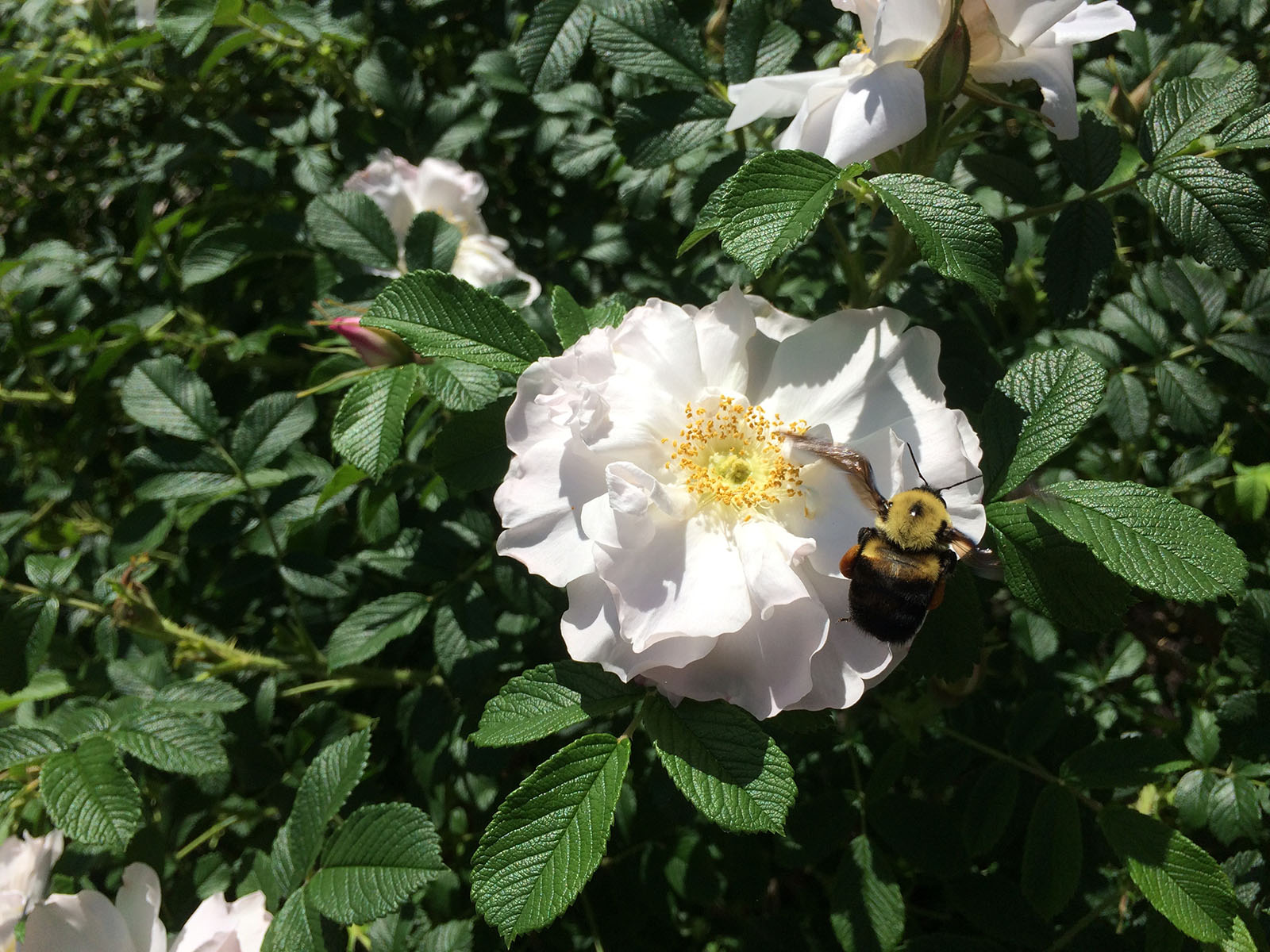
Lately I've been fascinated with watching the different types of bees visiting the flowers in my garden. I'll be sitting on the patio with my tea and the newspaper when I hear the distinctive buzz of a bumblebee on the nearby rugosa roses. When I get up to take a closer look, I notice that there are other types of bees on the roses also, and as I watch them for several minutes, I discover that the interaction between the different bees can be rather comical (which I'll describe after I introduce the characters).

The bumblebees in my yard are a little on the small side, except for the queen, who is huge. At one point when this bumblebee was hovering, I got a glimpse of a band of brown on her abdomen, which you can just barely see in this photo, leading me to suppose it might be a brown-belted bumblebee.


The description of the brown-belted species also notes that the queen is quite large, and it's a common species around here, so I'm going to say that's what it is.

Bumblebees have this habit of curling their bodies around the pollen anthers and then vibrating vigorously, which is a really effective way to get the pollen out of tomato and pepper plants because those flowers enclose the pollen in a cagelike structure and the extra vibration shakes the pollen free. The technique is called buzz pollination or sonication, and it's the reason bumblebees (and a few other bee species that do this) are the most effective pollinators of those crops. Honeybees don't do that, and neither do most other wild bees.

Bumblebees also flit about from flower to flower and back again, never spending much time on each visit. This is a very effective pollination technique for row crops because it results in a more thorough mixing of pollen.

Neither of these techniques are necessary for roses, but they don't hurt, either, unless you're a smaller bee working the same roses, and then the bumblebee's clumsy frenetic maneuvers can get rather annoying.

Here's one of the smaller bees at work on the roses. It's most likely a type of digger bee, so called because they nest in the ground. There are many such species, and I don't know which one this is, but it sure looks a lot like the one featured on this page about Minnesota bees.  There are many types of wild bees that nest in the ground, but they are solitary (not hive-forming) and harmless, so there's no reason to fear them. To help these bees it's important to not get too carried away with the mulch, because that denies them access to nesting sites. (Learn more about that in a post I wrote this spring.)


This bee was so still, I watched it for a few moments wondering if it was really alive, and then noticed that it was quietly munching on pollen. It's almost like it's kind of a zen bee, meditating on the roses.

And there's a still smaller bee, one that resembles an ant with wings, and is probably of the genus Ceratina, or small carpenter bees. They are called that because they chew holes in soft woody material, mostly cut plant stems, where they lay their eggs in brood cells. There are a few solitary bees that use plant stubble this way, and it's the reason you should leave some cut stems standing in your garden. Their jaws are not strong enough to be destructive, so no worries there.


The comical part, which I was not able to capture with my iPhone camera, came when the bumblebee visited a flower that already had another bee in it.

The small bee would be quietly minding its own business when the bumblebee stumbled into the flower and bumbled about, actually knocking the smaller bee off to the side away from the pollen.

Elbowing it out of the way like it was the roller derby!

Most of the time, the smaller bee moved out of the way and waited for the bumblebee to leave, which it did before long, and then the small bee would resume its meal.

But on another occasion, when I noticed both digger bees and bumblebees on my wild rose (Rosa blanda, a volunteer I decided to keep), the digger bee appeared to be attempting to fend the bumblebee off. I saw its tiny front legs come out on one side in a waving motion, as if it were trying to push the bumblebee away. The bumblebee appeared oblivious to this effort, buzzing right on the top of the smaller bee before moving along.

I just couldn't help but think it was like a bee version of a Laurel and Hardy routine. Who knew that backyard bee watching could be so entertaining?

Digger bee: "I think I'll wait for those galoots to leave before I attempt a landing."


Wednesday, October 7, 2015

Early October Garden Tour

Mums with licorice vine (Dichondra) and English ivy
I could say that I've been neglecting this blog because I've been busy taking care of my garden. But I haven't. Fortunately, my garden mostly thrives on benign neglect. Unfortunately, so do the weeds. (Blogs, on the other hand, don't seem to care one way or the other.)

Despite that, I've got some lovely things happening all around my neglected garden. Here are a few highlights, starting with the front.

The yellow-orange mums in the little concrete urn that sits atop the steps at the sidewalk have perked up nicely a day after I discovered them all droopy because I hadn't been watering them. (A hazard when you've had abundant rainfall all season -- you forget to water things when it stops!)

And now that the coralberry is starting to change color, I see that the leaves are a perfect match for the potted mum. I may have to move the pot to the other side so they don't get lost in the matching background, but I do rather like the hints of harmonious color at this stage.

Native coralberry (Symphoricarpos), with potted mums in the background

My hardy mums, planted in the ground near a dwarf Korean spruce, are a handsome bold red. Now there's some contrast for you.

Hardy mums in front of a dwarf spruce

Meanwhile in the backyard, the Prairie Fire crabapple is looking fabulous, and a few of the leaves are starting to turn, offering a hint of the show to come. The fruit generally lasts through the winter, depending on how hungry the squirrels are. A couple of years ago I had a delightful surprise when a flock of cedar waxwings filled the branches one spring afternoon and pretty much picked it clean. What a show that was! 

Prairie Fire flowering crabapple
Under this tree is a fairly large concrete birdbath, next to which I planted annual white salvia, which the bees have been enjoying this summer. 

Annual salvia, with lady's mantle in the upper left and the base of my birdbath in the upper right

And over in the corner by the garage and a "rocket" juniper, is the English lavender that has proven to be quite hardy in Minneapolis (USDA zone 4a). 


It even survived the polar vortex winter of a couple of years ago. We rake leaves on top of all the gardens but otherwise don't do anything extra to protect it. 

I've found that it's best to cut it back pretty severely in the spring and it'll send up lots of new growth. It starts blooming about midsummer and keeps going into fall. 


 This is Lavandula angustifolia, I'm pretty sure.


Over by the "kitchen garden," which is enclosed by a blue picket fence, are some bright marigolds mingling with the yarrow I transplanted to this spot after removing a diseased aster. I kind of figured that the disease, which looked like some sort of bacterial leaf spot, was in the soil in that spot, so I figured the yarrow and the marigold are unrelated enough to not be susceptible to the same disease. Neither appears to have been affected.


And when I was photographing the marigolds, I made the happy discovery of what I believe to be a sunflower bee (Svastra obliqua) -- it looks much like a large honeybee or small bumblebee, and is often mistaken for one or the other. But its size is in between those two, and its abdomen is more distinctly striped than the bumblebees that frequent my yard (Bombus impatiens, which have mostly black abdomens without stripes).

A closer look at the bee on the marigold

And just beyond that, the cosmos tumbling over the fence is hosting a Bombus impatiens.


Oh, and I mustn't forget the Henry Hudson roses, which are loving the cool fall weather. In fact, they retain a little more of the hint of pink now that the sun isn't shining so intensely on them.


And since I stopped deadheading it after early August, it has started to form the cherry red hips that Rugosa roses are known for. 


So there's your garden tour for early October. I'll take you on a little tour again later this fall  after the leaves are showier. 

And in the meantime, I'll have to get out and do some weeding, and planting --  I've got bulbs to plant! I ordered a whole bunch of them from John Scheeper's and they just arrived a few days ago. Time to get busy.

Friday, March 30, 2012

Trading cards, anyone?

Among the vintage ephemera that I have amassed over the past few years are a few small trading cards from Wills's Cigarettes, which have exquisitely crafted full-color images on one side and interesting trivia on the other, all framed with convenient little mentions of the sponsor's name. There's also a notice, in very tiny print in the margins, that you can purchase an album for displaying the pictures from any tobacco shop, for one penny.

Those cards are English (as in UK, that is), and I don't see a date on them, but a quick check on the Internet tells me that they were issued during the late 19th/early 20th century, and that complete sets of some of the series can be quite valuable.

In the book, Minnesota on Paper: Collecting our Printed History, authors Moira and Leo Harris write that trade cards reached the height of their popularity in the U.S. in the 1880s, and that, at that time, "the trade card was truly the most ubiquitous form of advertising in America."

And I, for one, can certainly understand the appeal of these little cards. As a maker and trader of ATCs (artists' trading cards), I am attracted to the artistry, the trivia, and the small format of such cards, although ATCs aren't quite as small as the Wills's Cigarettes cards; Wills's cards measure about 1.5" by 2.5" and ATCs are 2.5" by 3.5".

Little cards with art and information appeal to my arty didactic little heart. So, naturally, I thought I'd make some of my own, to promote my Etsy shop, of course, and, also, just for fun.

The bumblebee card is one of two with a Minnesota focus.
But because the cardstock I have that's heavy enough to make nice trading cards comes in a light brown color described by the folks at the Wausau paper mills as "driftwood," I thought it would look better to stick with black line art. And, besides, I already have ink drawings of animals, and some interesting trivia to go with it, which I made into note cards a while ago (and which are available for sale in my Etsy shop—here's the note card section, fyi).

The backs of the four cards are all the same
If you'd like to get a set of four Arty Didact trading cards (the size of ATCs—2.5"x3.5") for free (I'll even cover the postage!), use the envelope icon below to send me a message with your mailing address. I'll even throw in a couple of extra bits of Arty Didact original and unique ephemera while I'm at it. And if you want to be notified of art events that I'll be participating in (in Minneapolis/St. Paul), say so when you send me the message. If you don't request it, I won't mail you anything else—because I have no interest in wasting money just to annoy you.


The first set of four Arty Didact trading cards

Monday, May 16, 2011

Sweet Violets

I've been seeing lots of violets lately, in lawns and gardens and the crevices of sidewalks. They appeared about the same time as the dandelions, right after we had a hot day followed by lots of rain. I have no understanding, and certainly no sympathy, for those who consider them such a menace that they'll part with their hard-earned money to have some chemical company come and poison their lawn just to get rid of them.

Amongst the various definitions of insanity,  I'd suggest that poisoning your lawn and, subsequently the birds and other innocent creatures who visit it, in order to destroy a harmless little flower growing amongst the otherwise boring blades of grass really ought to be one of the top ten.

Common sweet violets (Viola odorata) and their cultivated cousins the pansies (Viola tricolor), and also all members of the viola family, are not only pretty, but also tasty mixed in a salad or decorating a cake. They're mildly sweet and, in truth, offer more in the way of edible decor than flavor. One of our neighborhood bistros, Al Vento, has grown pansies in the planter boxes surrounding their patio, and last spring, I remember the waiter snipping a few for the chef, who used them as a garnish with dessert.

Of course, we're not the only species that can enjoy violas as food. Rabbits will happily munch on them rather than on your garden plants, if the supply in your lawn is plentiful. Fritillary butterflies prefer them as larval plants, and recently emerged bumblebee queens appreciate the nectar after their long winter nap—and anything you can do to get bumblebees to stick around will increase the yields in your garden, especially on the tomato plants, which bumblebees pollinate better than any other insect.

Despite their delicate appearance, violets are tough and sneaky little flowers. Hence, all the efforts to eradicate them from lawns eventually fail. They spread by underground runners as well as by seed, which is why they tend to colonize a given area once they get started there. And when they are ready to go to seed, they nod and tuck their little inconspicuous seedheads out of site and near the ground, so regular lawn mowing doesn't even affect them.

They have some medicinal uses, too, though I've never tried to use them in this way. According to this site, the ancient Greeks used them to "moderate anger" and strengthen the heart, and one of the common names for both violets and pansies in old England is Heart's Ease. A delicious bit of irony, when you think of the people so irritated by them that they'll do anything to kill them.