Monday, February 3, 2014

14 Things about Valentine’s Day, No. 3: What’s Chaucer Got to Do with It?

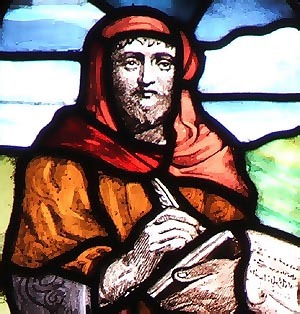
Geoffrey Chaucer
 In 1382, Chaucer published his story poem A Parlement of Foules, about a fanciful gathering of birds for the purpose of choosing their mates. He set the date of his gathering of the birds on St. Valentine’s Day, and because of this correlation, numerous scholars over the years have assumed that it was already customary to associate Valentine’s Day with love and romance, and that Chaucer’s poem was just reflecting an existing practice.

Except, when Kansas English Lit professor Jack Oruch dug into the historical record to find some evidence of this, he came up empty. In 1981 he published his very extensive research (see sources, below) concluding that Chaucer was the first on record to make a connection between Valentine’s Day and romantic love, and that he did so because it was a convenient day on which to set his story, not because of any existing societal customs.

Why, then, did Chaucer choose Valentine’s Day? Oruch explains at some footnoted length, but here are the pertinant points he convincingly makes.

First, to set a story at a vague time frame like “sometime around the middle of February” is terribly dull and unpoetic, and, anyway, in those days it was most common for people to date events according to the names given to specific dates in the liturgical calendar, which could mean a saint’s day or another religious observance. Even today, the spring semester at English colleges is known as Candlemas term, and the fall is identified either as Michaelmas term (in England) or Martinmas term (in Scotland).

If Chaucer looked to the middle of February for a catchy name for a specific day, he would have found, for the 10th, saints Scholastica and Austreberte; for the 12th, St. Eulalia; and for the 13th, depending on what calendar he consulted, either nothing, or St. Eormenhilde. Oruch points out that most of these names do not “lend themselves to verse and rhyme” (I would argue that Eulalia is the exception to that), or that they are associated with “unpromising legends of ascetic chastity.” (Eulalia was a 13-year-old virgin when she was martyred under Diocletian.)

St. Valentine not only possessed a name that was considered beautiful in his day, but the name was also associated with a well-known popular romance, as I explained in yesterday’s post.

And so, invoking his poetic license, Chaucer wrote:

For this was on seynt Valentynes day,
Whan every foul cometh there to chese his mate ...
(309–10)

And that, says Oruch, was the first time the Saint’s day was associated with mate-choosing.

Chaucer mentions the day a few more times in subsequent verses, and Oruch argues that the poet is using this reiteration, and describing quite specifically this annual gathering of the birds to choose mates “the character of which is carefully and repeatedly spelled out,” because he does not expect his audience to already know what he is talking about. As the ingeniously creative poet that he is, Chaucer is making up an elaborate tradition to embellish observed bird behavior and probably had no idea what social customs would arise as a result.

Subsequent works by Chaucer and other poets of the 14th and 15th centuries repeated this association, and it's in the 15th century that the historical record first shows evidence of gift-giving and romantic verse on the occasion of St. Valentine's Day.

Tomorrow I’ll take a look at the date itself, and our shifting calendar.


Selected Sources
Duncan, David Ewing. Calendar: Humanity's Epic Struggle to Determine a True and Accurate Year. Avon Books, 1998. (p. 131)

Oruch, Jack. B. "St. Valentine, Chaucer, and Spring in February." Speculum, Vol. 56, No. 3 (July 1981), pp. 534–565. (Accessed from JSTOR database via Hennepin County Library.)

“Valentine’s Day.” Wikipedia.
http://en.wikipedia.org/wiki/Valentine's_Day


Sunday, February 2, 2014

14 Things about Valentine's Day, No. 2: Medieval Romances and a Popular Name

The name Valentine is derived from Latin valere, to be strong, and was popular in the late Roman empire. Several emperors and a pope were so named, and more than 30 Valentines (and a few Valentinas) were made saints, having been martyred for their faith, although the two mentioned in yesterday’s post were the most prominent, and the only ones to have made it into the Dictionary of Saints. The name was also popular in the middle ages, and members of the nobility would often name their sons and daughters Valentine or Valentina simply because they thought it to be a beautiful name.

Surviving stories about the lives of our two Saints Valentine were written in the 6th or 7th centuries, explained Professor Jack B. Oruch in a meticulously researched article published in the journal Speculum in 1981.* And the scribes who wrote them down were not so concerned about historical accuracy as they were about telling good stories that illuminated the great sacrifices made by the Christian founders, and to uphold the mythic traditions that had formed around this relatively new religion.

It’s not that they were trying to deceive anybody, it’s just that they didn’t want to spoil a good story for want a few facts. If there were any court records of the trials and punishments of these saints, they were long lost, so the scribes tapped oral tradition and took some liberties regarding who did what to whom, mixing it all up into a tantalizing literary stew that illustrated the greater truths they were most concerned with—that the saints performed miracles of healing, effected conversions, suffered martyrdom for their faith, and were rewarded by God. None of which had anything to do with love, romance, or marriage.

But there was a whole genre of medieval literature emerging from the courtly love tradition that was all about love and romance —and heroism. You know the sort: knights in shining armor going on daring quests and rescuing hapless high-born damsels from fiery dragons, and all that. These are collectively referred to as romances, because they were thought to have stemmed from Roman storytelling traditions.

And in a collection of these romances associated with the Carolingian era in France (9th–10th centuries) were stories about a hero named Valentine. Professor Oruch summarizes the story like this:

“In the romance story, Valentine is of noble birth and grows up to perform deeds of valor, falls in love, wins his lady Clerimonde, and after many adventures kills his father in battle by mistake. For his unintentional crime, Valentine does an extremely long and difficult penance, living away from his beloved wife in utter poverty and humility; as a result, he dies a holy man, causes the sick who visit his tomb to be healed, and is soon made a saint.”

In describing the grief Valentine’s widow expresses upon learning of his death, the story emphasizes his virtues as a lover and husband. But, says Oruch, the part about him being made a saint wasn’t in the original story; it was added much later.

And nowhere is this romance associated with a particular date in February. But it does offer a glimpse into an association between the name Valentine and traditions of romantic love eventually connected to it.

 •          •          •          •          •          •          •

* Oruch, Jack. B. "St. Valentine, Chaucer, and Spring in February." Speculum,Vol. 56, No. 3 (July 1981), pp. 534–565. (Accessed from JSTOR database via Hennepin County Library.)


Saturday, February 1, 2014

14 Things about Valentine's Day, No. 1: Who was this St. Valentine anyway?


I'll confess I'm rather fascinated with Valentine's Day, and not because I am a hopeless romantic. I'm actually not much for romance at all (with apologies to my husband, who already knows this). Rather, Valentine's day is packed with so much folklore, mythology, history, custom, and, best of all, misinformation, to make my trivia-loving, myth-busting self positively gleeful.

Since I've gathered too much information about the annual love-sodden observance for a single blog post, I thought I'd offer a bit of a countdown — 14 things about Valentine's Day that you might not already know. One curious bit each day, in no particular order, for your amusement and edification.

Let's begin with the saint himself. Or themselves, perhaps. But first, the popular myth, a version of which goes something like this:
-----------------
During the late Roman empire, the emperor had become so frustrated by the reluctance of married soldiers to leave their wives and children behind to serve on the far flung perimeters of the empire, that he banned marriage altogether.  The kindhearted priest Valentine performed secret, illegal marriages anyway, and so was imprisoned and then executed for his defiance of the law. While in prison, he wrote sweet epistles to the jail-keeper's daughter, signing them "Your Valentine."
-----------------
I rather like this myth, because it points to the day as an occasion to champion legal marriage for all, and to work for fairness and equality for those to whom legal marriage is denied. Even though that's no longer an issue in Minnesota, one need not look far to find plenty of evidence that the cause has a long way to go. Too bad there's no basis for it.

The marriage-hating emperor is usually identified as Claudius. But fans of I Claudius will be relieved to know that historians have determined that no persecutions occurred during the reign of that Claudius, and so it has been assumed that these incidents must have taken place under the rule of Claudius II, or Claudius the Goth, who ruled much later, in the third century CE.

According to the New Catholic Encyclopedia, there are two martyrs named Valentine who are both commemorated on the 14th of February. Both were beheaded, one at Terni, which is about 60 miles from Rome (he is thought to have been the bishop of Terni), the other at Rome, where he was a priest. The Roman Valentine was said to have died in about 269 CE, apparently for having converted an entire household to Christianity after miraculously restoring the eyesight of the once blind daughter of his host. (The father's joy at this miracle would have been short lived, as he was executed also.)

Another account has the bishop of Terni curing a crippled child, which led to the saint being regarded as the patron of those afflicted with the "falling sickness," or epilepsy. (An entertaining overview of the various causes the saint is associated with, along with an accounting of his various scattered remains—that is, relics—is offered here.)

As with the first story, the miracle led to the conversion of an entire family of the Roman nobility to Christianity, and thus the offending bishop was beheaded. Or this may have been one and the same Valentine: "Whether there were actually one or two Valentines is disputed," says the editor.

The problem with that account, according to University of Kansas professor Jack. B. Oruch, is that Claudius II, who only ruled from March 268 to April 270 (hence the date given for the saint's martyrdom), spent nearly the entire time away from Italy on military campaigns. And there is no evidence, other than the saints' legends written much later, to suggest that this Claudius had reversed the policy of toleration established by his predecessor.

There's also nothing in the historical record about marriage having been banned. That story arose many centuries later. Indeed, none of the legends about the saint had anything to do with love or romance. That association came much later, and will be the topic for another day.


•          •          •          •          •          •          •

Sources


Day, E. “Valentine, St.” New Catholic Encyclopedia, 2nd ed., Vol. 14. Detroit: Gale, 2003. 371–372. Gale Virtual Reference Library. (Accessed via Hennepin County Library.)

Delany, John J. Dictionary of Saints. Doubleday, 1980.

Oruch, Jack. B. "St. Valentine, Chaucer, and Spring in February." Speculum, Vol. 56, No. 3 (July 1981), pp. 534–565. (Accessed from JSTOR database via Hennepin County Library.)


Wednesday, November 27, 2013

Stuff! Or a treasure box by any other name

When my kids were school age and I was looking for ways to practice basic math operations, I modified the rules for scoring rummy, counting each card at face value, with Jack=11, Queen=12, and King=13, so that we got lots of adding practice. But when it came to learning multiplication, I was stumped. I tried to think of an alternative way of scoring some familiar game and came up blank, so I made up my own game using dice and dubbed it Roll 100 (making the goal to get a score close to 100 through a combination of multiplication and addition).

The current version of my dice game.

Some years later, when I started getting into crafting, I thought I'd have a go at selling these games, putting them in assorted repurposed candy tins and setting them out on a table at the first Barton School Arts from the Heart craft fair one winter.

They sold reasonably well, but they attracted the most attention from kids too young to do the math. It was apparent that the colorful dice in a small tin held a certain allure apart from whatever function I had intended for them. I recall one mom buying one for her preschooler after he could not be persuaded to select something more age appropriate.


Which led me to the idea to put an assortment of dice and random objects in little tins for small children to do whatever they like with them. Not sure what to name my new product, I recalled a coloring book that artist Tom Cassidy made for his son, which he named Yikes! Stuff Everywhere; and so named my little tin of objects Stuff!


I see them as a kind of loose assemblage for kids, a random assortment of kid-pleasing objects, like buttons and old keys, game tokens and flat marbles. I looked for things to put in the Stuff! tins at estate sales and garage sales, and then started adding some new items, like tiny rubber animals made by Safari Ltd.

I enjoy collecting these various small items for the tins, it gives me an excuse to do something I am inclined to do anyway.

Stuff!

Creating original collages for the lids of the tins is the obviously arty part of the process, but so is the selecting of items to put in them; and fitting as many as I can while still making it possible to close the lid involves some creativity as well as spatial skills.


Some people ask me about the boxes and their purpose, although most don't need to be told; they understand them intuitively. So, while I sometimes struggle to "explain" them to folks who don't really get the concept, I have also discovered that the ones who do get it offer helpful descriptions I could use, calling them treasure boxes, for example.

A treasure box full of stuff everywhere. That pretty much sums it up.


Tuesday, November 19, 2013

How to get the proofreading done

Latte and a scone at Parka


When there is proofreading to be done, and it's a few hours of reading, which I really can't do all in one sitting, I find the best approach is to pack it up and head out on my bicycle to a coffee shop.

After a couple of hours' worth of reading, I get back on the bike and head to a different coffee shop.

One time while doing my proofreading at one of these neighborhood spots, one of my friends who is a freelance writer told me how, many years ago, she would take her work to the bowling alley and have a cup of coffee there. It was the only spot open on a Monday when the local bakery was closed. She did not go there for the coffee.

I am pleased to have better options these days.

Sunday, October 20, 2013

It's Show Time!

Stuff! A random collection of small toys for kids.

Arty Didact (that's me) and other clever crafters will be selling handmade goods at the following events:

Nokomis Urban Craft Fair
Nokomis Community Center
2401 E. Minnehaha Parkway, Mpls. 55417
Saturday, Nov. 2, 9 a.m.–3 p.m.

Barton Open School Handmade Arts from the Heart
Barton school gym
4237 Colfax Ave. S., Mpls. 55409
Saturday, Nov. 9, 10 a.m.–3 p.m.

Book Arts Festival
Minnesota Center for Book Arts
1011 Washington Ave. S., Mpls. 55415
Saturday, Nov. 16, 10 a.m.–5 p.m.
(I won't have Stuff! sets or bottlecaps at this one.)

HandmadeMN Fall Market
Ballentine VFW Post No. 246
2916 Lyndale Ave. S., Mpls. 55408
Saturday, Nov. 23, 10 a.m.–5 p.m.

Women's Art Festival
Midtown YWCA
2121 E. Lake St., Mpls. 55407
Saturday, Dec. 14, 10 a.m.–5 p.m.

A coptic stitch journal with beads in the spine
At the shows, I'll bring handbound journals, prints of my artwork (including tiny prints inside bottlecaps), book plates, mini chapbooks, calendars, cards, games, and quirky collections of small toys in little tins for kids.

Felted wool needle cases like this one are available from ArtyDidact on Etsy
Other items, such as needle cases, little purses and some artwork, will be available only through my Etsy shop. If you live in Minneapolis/St. Paul and wish to pick up your order instead of having it mailed, just use the contact option on Etsy to let me know and we'll make the arrangements (and, of course, I'll refund your shipping charges).

This post with the links to all the above craft shows is also available over in the righthand column under  Various Things, should you want to find it again sometime later.

Saturday, September 14, 2013

Somebody Else's Chickens


Today was the Twin Cities Coop Tour. A self-guided tour of homes, a couple of businesses and a school in the city and suburbs that have chickens. I was intrigued; I printed out the map and marked a few nearby addresses to consider visiting.

Craig said, "I've seen a chicken before."

I said that I'd like to see some chickens, but that I wasn't feeling ambitious and didn't want to have to drive anywhere.

So we rode our bicycles to visit one spot on the tour, the one nearest us, by Lake Nokomis.


This is Mike, and his hens all have names, but I don't remember what they are. They just got their chickens this spring.


I asked why they keep chickens. For the eggs, he said, and because we wanted our daughters to have the experience.

He then explained that they have a 4-year-old attending preschool at the Dodge Nature Center, which has chickens, and one of the teachers there asked Mike and his wife, Britt, if they had chickens. They were surprised by the question.

The teacher explained that the little girl was so completely at ease with the chickens, confidently plucking the eggs out from under them and picking them up, that she figured they must be a familiar thing at home.  Britt wondered aloud, "People keep chickens?"


A week or so later, as Mike tells it, Britt said again, "People keep chickens?" But this time her tone sounded more intrigued than taken aback.


"Next thing I knew," he said, "I was building a coop."

These are winter hardy chickens, he explained. They can stay outside year round. In fact, the heat is a bigger concern for them than the cold. Their coop and adjoining run are situated under the shade of a large tree, and, as you can perhaps see, has vines clambering over it to provide even more shade.

The coop itself is above ground so that there's room under for the chickens to seek shelter from the rain and find dry ground at all times.


I asked if they let the chickens roam in the garden. I had always figured that for a gardener, keeping chickens meant free fertilizer and bug patrol. But they also eat plants, and will eat all of them if allowed to roam freely, so they're only allowed in the garden some of the time, Mike explained.

And, for the record: No, I don't want to keep chickens. But I'd love it if one of my neighbors did, so I could visit them.

Tuesday, September 10, 2013

Linear geometry


Our backyard and the alley behind our house are criss-crossed with power lines, like buntings missing their flags, connecting poles to houses and other poles, linking our house to other houses and garages and the new apartment building on the corner and across streets and more alleys, sometimes departing from their alley routes and running alongside residential streets, where too-tall trees have been pruned ungracefully to accommodate their relentless progress, which eventually connect the houses on my block to a cluster of wires and structures looking like something out of a futuristic model city surrounded by a tall chain link fence on Hiawatha Avenue.


From there, bundles of wires and cables travel high above Hiawatha, which is one of our major thoroughfares known also as Highway 55, past grain elevators still in use and new construction in process where other grain elevators used to be, alongside railroad tracks that are only used for a few weeks in the spring and fall, stretching to downtown and then on out of the city to the nuclear power plant in Monticello, as well as a wind farm somewhere on a prairie in the western part of the state, although that last bit may be only wishful thinking on my part.

We sometimes sit on our backyard patio on summer evenings looking east, watching clouds turn pink in the evening beyond those criss-crossing lines.

My drawing of the hapless power pole canister, before it exploded
At our previous home, there was a large rusty-looking tin can attached to the power pole, with wires and coils and pipes sticking out from it here and there. It often became a focal point of our evening conversations over a bottle of wine as we speculated about its contents and function. Sometimes we imagined it to be a Rube Goldberg device powered by squirrels. Sometimes we wondered if it could be a nuclear reactor in miniature.

Then one July day the thing blew itself up with a loud POP!, allowing nothing more than a curlicue of smoke to escape, leaving it with a jaunty-looking topknot of twisted, blackened wires. It was soon replaced with a shiny new cylinder, with no interruption in power to our home in the interim. This did nothing to diminish its mystery in our minds.

I like the power lines and the poles with their mysterious numbers and other markings. I appreciate their linear geometry, the contrast of these structures and lines with the soft amorphous forms of the clouds and the mottled green expanse of the maple tree that towers over our neighbor's backyard and the alley; the way the birds perch on them as though that is the very reason they were erected.

They provide a visual reminder of our connection to points near and far, the relationship of the built to the natural landscape. Even as we sit in our own backyard.