Showing posts with label gardening. Show all posts

Monday, August 10, 2020

With apologies to the bees and goldfinches


I'm not the most fastidious gardener as a general rule, and when a relentless heat wave like we experienced for nearly all of July comes along, I'm even worse. There were a few days at the beginning of the month when I got out in the garden early in the morning (like, around 6 a.m.) intent on making at least the most public part of my front garden presentable, and I did accomplish that much anyway. But for the rest of the month I looked out through my windows at the rampant weeds and said, "mmmm ... maybe tomorrow."

I favor a not-too-tidy cottage garden look, with an emphasis on native plants balanced with and contained by a few old-fashioned staples, like peonies, disease-resistant roses, and a boxwood hedge. 

I planned the garden with birds, bees and butterflies in mind, and placed a bird feeder in the front yard where we could see it from our dining room windows. Knowing the spilled seed would mean a lot of weeds (mostly sunflowers), I tried to design it so that the messiest areas would be screened somewhat from the street view: there's a serviceberry (Amalanchier laevis) and then a row of boxwood between the feeding area and the front edge, with a "terraced" flower garden next to the sidewalk (shown here in August when it's mainly just the mums blooming).

("Terraced" is in quotes because the front edge of the yard is set off by a low retaining wall we made from chunks of concrete after taking up a sidewalk in the back. A second row of sidewalk chunks is arranged a few feet back from that, in front of the boxwood. Hence, it's a "terrace.")

Respectability isn't the only reason to weed and maintain a garden, of course. Weeds tend to hog water, nutrients and sunlight, and they'll take over everywhere if you don't yank them out once in awhile, such is their nature. 

But the birds and bees don't care about any of that. I have let bindweed get way out of hand after seeing a hummingbird nectaring from its small pinkish white flowers, and now we are struggling to untangle the bindweed from everything else, including the volunteer sunflowers around the bird feeder.

A mystery mint showed up in the flowerbed next to the front steps earlier this summer, standing out conspicuously as it loomed over the coral bells and low growing vinca surrounding it. I kept putting off doing anything about it until I had the time and inclination to weed that whole garden. Knowing how aggressive mints can be, I finally decided that I had to just go yank it out and leave the rest of the weeding for a cooler spell. 

Then one morning as I sat at the dining room table drinking my tea, I noticed goldfinches landing on the swaying mint plant and happily plucking something from it again and again. I don't know what, exactly, they were eating, but I didn't have the heart to spoil their fun, so I let it go a bit longer.

Finally I did yank it, and a few of the surrounding weeds. Not long after, the goldfinches had moved on, and were plucking petals from my neighbors' tall zinnias. 

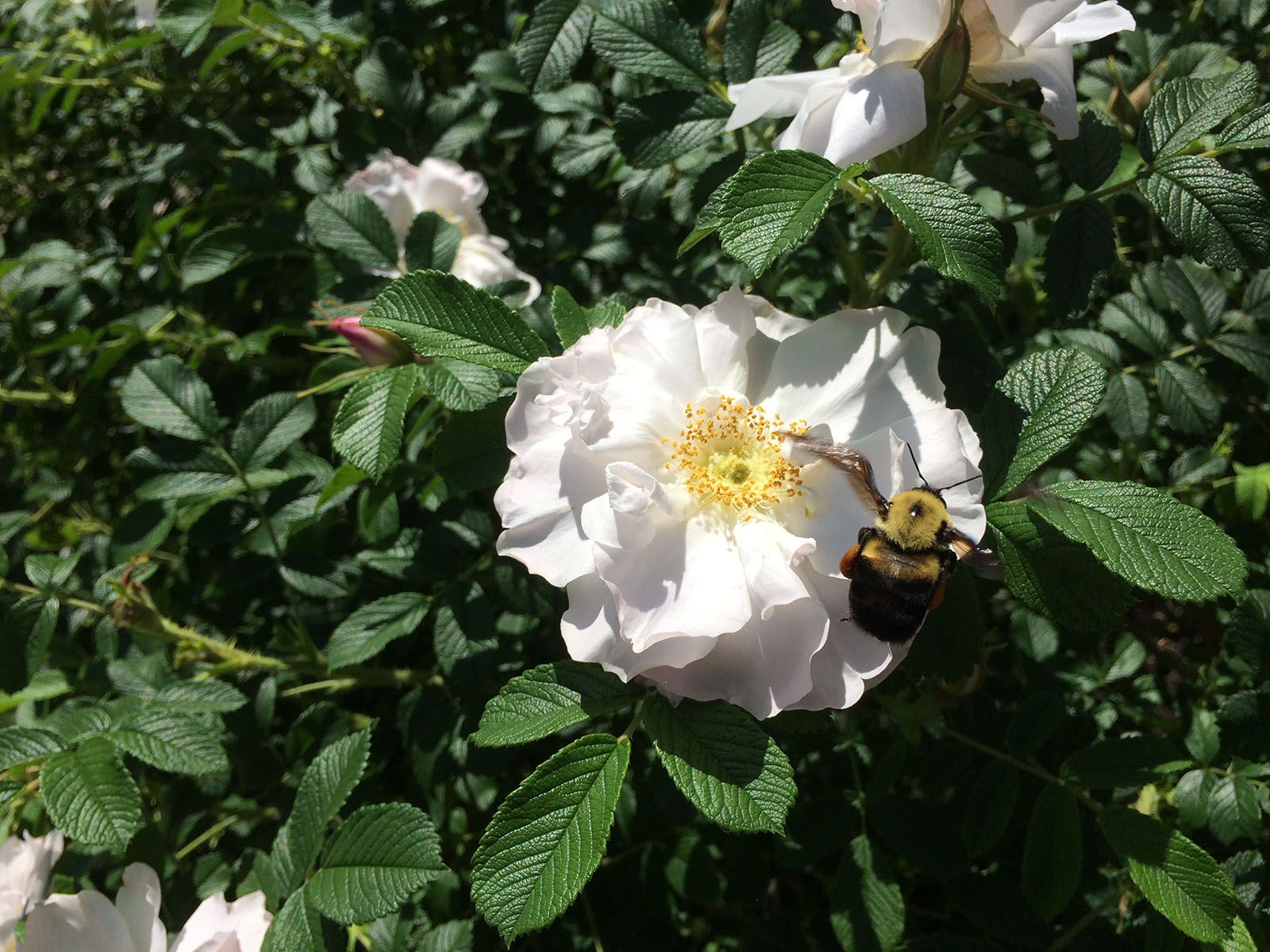
I also cut back the catmint (Nepeta), which the bumblebees really love. Like other members of the mint family, it kind of over-grows itself and falls open at the center; the stems get too long and flop over, and the flowers fade and lose their charms. The bees continued to visit the blossoms even as I was cutting the whole think way back. I laid a blooming stem aside on the front step for a few moments because a bee wasn't finished with it yet. 

But the bees, like the goldfinches, moved on to other flowers. (They especially love my repeat-blooming Henry Hudson roses in the backyard, below.) And the catmint will be blooming perkily again by September.


Monday, July 15, 2019

An ode to chamomile and shade

One day last week I got out into the garden early so that I could do a little weeding in the shade. The chamomile, which scatters its seeds rather widely next to the fence where I was working, was still shaded also, and so its petals drooped, awaiting the sunlight.

Drooping petals await the morning sun.
Once the sun cleared the tree across the alley and its light fell on the chamomile, the flowers came alive. The white petals perked up and spread out around the yellow centers, the sweet appley fragrance rose invisibly, and dozens of tiny flower flies showed up, fluttering daintily from one blossom to the next.


The flowers open, the flower flies come.

It made me think of a poem by Japanese poet Ryokan (even though it's about butterflies). 

The flower invites the butterfly with no-mind;
The butterfly visits the flower with no-mind.
The flower opens, the butterfly comes; 
The butterfly comes, the flower opens.
I don't know others,
Others don't know me.
By not-knowing we follow nature's course.

[From Dewdrops on a Lotus Leaf: Zen Poems of Ryokan, trans. by John Stevens. Shambhala Publications, 2004.]


Harvesting chamomile on a not-so-hot day in the garden


I try to keep up with harvesting the blossoms to dry for tea, not so much because I drink a lot of chamomile tea, but because if I let them all go to seed, they stop blooming and the plants dry up and that's the end of it. If I keep harvesting, they will keep blooming all summer. I don't worry about picking so many that I keep it from reseeding; it's really not possible to do that.

I usually pop off the blossoms with my thumbnail and into a bag while sitting on a chair that I bring out to the garden. But harvesting those prolific blossoms can get tedious even while sitting, especially in the sun on a hot day, so with temperatures in the 80s already at 10 a.m., and climbing to 90-plus pretty quickly, I took a scissors and cut off several bunches, then sat down in the shade of our patio umbrella to pop the blossoms off and into a paper bag for drying in the garage.

A thumbnail is a very handy tool for separating the blossoms from the stems.

A lot of the flowers were already past their peak and destined for the compost, so I placed my harvest basket on the table to hold a handful at a time from the bucket where I had put all the cuttings, with my paper bag between my feet for dropping in the blossoms. A second bucket collected the compostable leftovers.


A mass of chamomile stems and flowers in the shade of the patio.

For drying the flowers, I use a grocery bag that's been cut down to half its height, plucking the blossoms so they fall into the bag until there's enough for a single layer at the bottom, then set the bag on a table in a dark spot in the garage where they won't get sunlight to turn them brown, and leave them for several days to dry; I leave the bag open for maximum air circulation. We don't put our car in the garage in summer (much easier to get our bikes in and out that way), so there's no exhaust fumes to spoil the herbs. 


A glass of iced tomato-veggie juice aids the harvest on a hot day.

I've got some spearmint growing in a pot this summer, so I'll be sure to dry some of that, too. It complements the chamomile very nicely in an herbal tea blend, which tastes pretty good iced on a summer evening, when shade from the house falls on the patio and reaches across the backyard. 

Pretty soon the chamomile is shaded too, and the petals fold down, as if tucking themselves into bed for a good sleep before the morning's visitors arrive.

Chamomile with poppy petals and a tiny bee (probably Ceratina genus), on a morning in July.


Saturday, September 14, 2013

Somebody Else's Chickens


Today was the Twin Cities Coop Tour. A self-guided tour of homes, a couple of businesses and a school in the city and suburbs that have chickens. I was intrigued; I printed out the map and marked a few nearby addresses to consider visiting.

Craig said, "I've seen a chicken before."

I said that I'd like to see some chickens, but that I wasn't feeling ambitious and didn't want to have to drive anywhere.

So we rode our bicycles to visit one spot on the tour, the one nearest us, by Lake Nokomis.


This is Mike, and his hens all have names, but I don't remember what they are. They just got their chickens this spring.


I asked why they keep chickens. For the eggs, he said, and because we wanted our daughters to have the experience.

He then explained that they have a 4-year-old attending preschool at the Dodge Nature Center, which has chickens, and one of the teachers there asked Mike and his wife, Britt, if they had chickens. They were surprised by the question.

The teacher explained that the little girl was so completely at ease with the chickens, confidently plucking the eggs out from under them and picking them up, that she figured they must be a familiar thing at home.  Britt wondered aloud, "People keep chickens?"


A week or so later, as Mike tells it, Britt said again, "People keep chickens?" But this time her tone sounded more intrigued than taken aback.


"Next thing I knew," he said, "I was building a coop."

These are winter hardy chickens, he explained. They can stay outside year round. In fact, the heat is a bigger concern for them than the cold. Their coop and adjoining run are situated under the shade of a large tree, and, as you can perhaps see, has vines clambering over it to provide even more shade.

The coop itself is above ground so that there's room under for the chickens to seek shelter from the rain and find dry ground at all times.


I asked if they let the chickens roam in the garden. I had always figured that for a gardener, keeping chickens meant free fertilizer and bug patrol. But they also eat plants, and will eat all of them if allowed to roam freely, so they're only allowed in the garden some of the time, Mike explained.

And, for the record: No, I don't want to keep chickens. But I'd love it if one of my neighbors did, so I could visit them.

Monday, July 8, 2013

What were they thinking?

The previous owners of our house, Harry and Julia, had a thing for placing bricks in the ground.

Not those solid landscaping bricks that can make very charming edging, patios, and pathways -- regular building bricks with holes in them.


Nor did they submerge them on their sides to hide the holes; they placed them so that the holes were facing up.

So, naturally, plants planted themselves in the holes. Like grass, weeds, and these ferns.


Along the north side of the garage, which is one of the first areas that we completely relandscaped, they not only placed dozens of these bricks, but then they planted hostas all in a row alongside the bricks, which, when placed on top of the ground with their holes exposed, make really excellent slug habitat. The bricks were not only full of slugs, but you can probably imagine what the hostas looked like.

I can't help but wonder, what were they thinking?


We've been repurposing the bricks in various ways, such as defining the edge between the rain garden and a perennial border. Even though the holes are partially exposed here, we haven't had any slugs move in, probably because there are no hostas to feast on, and the slimy little critters would have to crawl across the open rocks to get to the holes, and we have a whole family of hungry robins hanging out, just waiting for them to do that.


Lately I've been digging out a row of ferns on the north side of the house and replanting them in a shady garden bed in the front, where they should form a pretty backdrop and obscure the plain gray concrete foundation blocks.

But sometimes the ferns and the bricks are hopelessly entangled, and there's no solution but to slice off the ferns and toss them in the compost.


In other instances, the bricks are already cracked and easily split apart, leaving an ogee-like impression of root mass.


We're reusing the bricks in various places around the yard, laying them in the ground sideways on a base of sand, with the holes (mostly) submerged, in combination with salvaged patio blocks and chunks of concrete. And when we run out of found bricks, I will probably go out and buy some more in order to edge more of the gardens with them, because I have a thing for bricks, too.

But I'm going to get the kind without holes.


Tuesday, June 25, 2013

Wrenifications


The wren first appeared in our backyard a couple of weeks ago, announcing his presence with what the Cornell Lab of Ornithology describes as a “rush-and-jumble song.” I was delighted to see him checking out the small bird house near the patio, then became alarmed when he headed over to the slightly larger one by the kitchen garden, because I thought the chickadees were still using it.

Wrens are known to be real estate hogs, stuffing many houses with twigs to form “dummy nests” so that other birds can’t use them; they sometimes go even further than that and actively eliminate the competiton. According to Cornell, wrens are sometimes the main reason for nest failure of bluebirds and chickadees, as well as some other species, which is why many birders don’t like them. So I was worried that the little fellow was going to do harm to the chickadee chicks.

I scurried over to shoo him away, saying, “You get away from there! That’s the chickadee house! You use the other house!”

“You’re talking to a bird,” said my husband from his seat on the patio.

The wren scuttled onto a perch in our neighbor Sue’s lilac bush, and I noticed that she had a bird house next to her garage also. Aha!  No wonder our yard is a magnet for the little speculator.

I didn’t hear any peeps coming from the chickadee house, so I decided to inspect it to see if the chicks were okay (a well-designed bird house will be easy to open so you can keep an eye on its inhabitants). What I found was a clearly abandoned nest. I then remembered seeing chickadees in the lilacs about a week ago, fluttering their wings like fledglings, but as they looked identical to the adults (not scruffy like robins) and I did not see them on the ground, I hadn’t put two and two together.

So I apologized to the wren, and he was soon happily stuffing twigs into both of our bird houses and, I suspect, Sue’s as well.

“In spring, the male establishes a small breeding territory by singing from exposed perches and putting stick foundations in prospective nest holes,” wrote Donald and Lillian Stokes in their Field Guide to Birds.

After several days of this, there was suddenly a noticeable absense of the wren’s musical bravado in the morning. Had his mate selected some other house down the block? If so, I was indeed sorry. They may be bad birds, but they’re voracious insectivores, and as a gardener first and bird watcher by extension, I would dearly love to have a family of wrens on pest patrol in my garden.

Then one morning I heard not only his by-now familiar burbling call, but a whole lot of chittering. I looked out the window to see two wrens engaged in a lively discussion as one perched on a nearby branch while the other went in and out of each of the houses.

It was fun to see this “songful tour of inspection,” as described by Christopher Leahy in The Birdwatcher’s Companion, after which the female chooses a nest and finishes it. And she’s a clever bird in setting up housekeeping, for she is known to stash a few spider egg sacs in the nest so that the spiders will devour any parasites that may infest the chicks, say the folks at Cornell.

I’m having a hard time telling which house she chose, as they appear to be dallying about both houses still. They are very active little birds, and the sexes look alike, so I find myself wondering if there is, indeed, only one female. According to Leahy, the name wren, which comes from the Anglo Saxons, has a traditional second meaning of one who is lascivious, possibly because of the polygamy of male wrens.

Sunday, June 16, 2013

Another Harvest of Little Blue Flowers, as Henry Hudson Looks On

I'm happy to announce that summer has finally arrived in Minneapolis. A friend recently posted on Facebook an overheard comment that pretty much sums it up for all of us: "Looks like summer finally got the memo."

Although the patio, on the east side of the house, is a little too sunny in the morning, there is a little period from about 9:30 to 10 or so when the huge maple tree across the alley casts a bit of dappled shade just where we need it, so we took our tea and the Sunday paper out to sit on the patio for a bit.


The Henry Hudson rose that we planted next to the patio last summer seems quite happy with its morning sun, though.

Once the patio was back in full sun again, we took advantage of the brief morning shade in one of the sunniest parts of our yard, just west of the garage, to do a little digging and transplanting. It's the previous owner's former perennial garden, which had become a raspberry thicket by the time we bought the house, so we've been having at it from time to time, replanting some of the raspberries to a different spot and discovering what else has been growing there under the thorny canes, besides dandelions and tall lawn grasses, that is.

Among the gems hidden amongst the raspberries was this dictamnus (aka gas plant) that I transplanted a couple of weeks ago. As you can see, it has taken happily to its new home.

Craig digs, I transplant. We have to do this side by side because Craig will go at the job with abandon if I'm not there to say, "Stop! Those are daffodils! And those are grape hyacinths!" (To be fair, the strappy leaves do look a lot like grass by this time.) So, dig and replant was the theme of the morning. I've been trying to do most of my transplanting during the week when he's at work, but last week I was too busy with other things and he was anxious to get on with the job of clearing this area out so we can replant it in some sort of orderly fashion.

There are some pretty blue flowers that I forget the name of (I figured it out last summer, but I'm not sure where I wrote it down; some sort of verbena or vervain, I think). I transplanted a few clumps, but much of it is overgrown, falling open at the center, and the lower leaves are looking spotted and unhealthy, so I am only transplanting the separate stands here and there that are smaller and healthier. However, I hate to throw the pretty blue flowers in the compost, so I harvested nearly all the stems from the big clump and brought them inside for a bouquet.


I also hated to toss the confetti of little flowers that fell on the counter top while I was trimming the stems, so I gathered them into a small bowl and placed it on the table to be ready to catch some of the others that fall. It's not the best florists' flower, for all of its flower-shedding tendencies, but I sure like that riot of little blue blossoms.


Tuesday, June 4, 2013

Transplanting and bouquet gathering

One portion of the fernleaf peony in its new home.
The rules for digging up and transplanting or dividing perennials are pretty simple: do it when they are first emerging, unless they normally flower early in the season, and then it's best to wait until late summer, long after they're done flowering. Or something like that.

But what if it's raining every day and you are still dealing with a big messy weedy patch where a garden used to be, and you really want to transplant all the good stuff as early in the summer as you can so you can clear the rest of it out and get on with doing something else with that corner of your landscape?

Well, then you just muddle along as best you can.

I once asked a Master Gardener if I could get away with transplanting a perennial in the middle of summer, during hot weather. She said, "Yes, if it doesn't realize you're moving it." Gardeners often speak of plants as if they were sentient beings, so I had no trouble understanding what she meant: dig it up in one big clump without disturbing the roots.

This is more easily done with some plants than with others. So when I tried to dig up the fernleaf peony (Paeonia tenuifolia), even as it had flower buds forming, I was dismayed when the roots fell apart as I attempted to lift it from the ground. It was an old peony and was due to be divided anyway, but late May is not the time to divide peonies!

So I performed a little triage, removing all the stems that had flower buds on them and bringing them indoors to put them in a vase, then transplanting about half the plant. I'll transplant the other half too, once I decide where I want to put it. I'm sure I won't see any more flowers on this plant this year, but it will have plenty of time to adjust to its new home and should bloom happily next spring.

The newly transplanted dictamnus, next to a successfully relocated lily.
The other plant on the verge of flowering that I dug up, with more success, was the dictamnus, or gas plant (Dictamnus albus). After the experience with the peony, I tried a different approach. First I sharpened my spade with a file, then I shoved the spade into the ground all around the plant before attempting to lift it, and as a result I got a pretty intact root clump, dirt and all. It helps that the ground has plenty of moisture in it from all the rain we've been getting.

I was careful to plant it at exactly the same depth as before, but with a hole that was a bit wider than the root ball, then filling in around it with little or no disturbance to the roots. Still, there were a few stray stems, so I cut those off and brought them in to add to the bouquet. I also moved a lily, but that won't bloom until late July or August, so it isn't showing any sign of forming buds yet.

Finally, I took some flowers from the mountain bluet (Centaurea montana), because I plan to move that one soon as well. And a little blue in the bouquet seemed like just the right complement for those dark red buds from the other two flowers.

It remains to be seen if the dictamnus will proceed to blossom as normal. If the flowers show no sign of opening after a reasonable period of time, I will have to cut it all back a bit so the failed buds don't deplete the plant's energy.

My bouquet of mostly closed flower buds is not particularly showy, but I enjoy the understated mix of foliage dotted with blossoms (that is one of the perks of having a fernleaf peony -- the great foliage). And I'm a couple of steps closer to taming the backyard, which is actually worth the sacrifice of a few flowers here and there. Like a good bouquet, a pleasing landscape is more about the composition than about the individual elements contained within it.

Tuesday, April 24, 2012

Willowy

You know those curly willow branches you can buy in bundles for floral arrangements and pots? I really like those, and I thought it would be nice to grow my own, which would be easy enough, since they root readily when you stick them in the dirt.

But willows can grow up to be monstrosities, so I am experimenting—I put them in a half-whiskey-barrel planter last summer, and set it next to the house and air conditioner, on the south side, in a space that isn't really well-suited for much else anyway. I figured that if they didn't make it through the winter grown in a container like this, I was none the worse off, since I had bought the twigs for the previous winter's front step arrangement, and so wasn't investing money in a plant of marginal hardiness only to risk seeing it perish in a Minnesota winter.

Last winter didn't really qualify as a Minnesota winter, it was more like Seattle, or something. So of course the willow cuttings came through just fine.


They've sprouted a lot of small, delicate stems so far, which look lovely in a vase with some daffodils. It remains to be seen if I'll get any larger, showier specimens from it, but I'm rather liking it so far, anyway. If it simply fills the barrel with curly willow stems, that will be all right with me, too.

Saturday, April 14, 2012

Playing apothecary


Not surprisingly, my lavender plants came through the unusually mild winter very nicely. Today I moved them to a sunnier spot, one that was just lawn last summer; but after sitting through the fall and winter under layers of newspaper and a covering of woodchips, the turf was beginning to break down nicely, so I dug four holes and placed the lavender plants in them. It's supposed to rain again tonight. Perfect.

I had a nice quantity of lavender buds from last year, sitting in a jar all winter, and I was pleased to discover that when I started to mash them with my mortar and pestle, they still had plenty of lovely fragrance.


The buds don't quite get ground into a powder this way, their texture kind of reminds me of rubbed sage. Soft like that. I added them to a mixture of cornstarch and baking soda to make my own body powder, something I've been meaning to do for some time now. I'm happy to report that it turned out fine and has a lovely fragrance.

Here's the recipe:
1 1/2 cups cornstarch
1/2 cup baking soda
1–2 Tblsp lavender buds, ground as finely as you can

Mix it all together, and you're done. And just in time—it was surprisingly warm and humid when I was working in the garden today, moving those lavender plants, but I didn't work long or hard enough to get truly sweaty and dirty, just a little moist.  So a freshening up with a bit of my newly made powder was just the thing.

This little shaker holds about a third of the total, the rest is in a pint jar, ready for refilling. I tied a few more lavender buds inside a bit of cheesecloth and placed it in the jar to infuse the powder, because I wasn't sure I had ground up enough of them. I might try just doing it that way next time anyway. Or buy a spice mill for easier grinding. Although there is something satisfying about working with the old mortar and pestle, like a medieval apothecary.