Showing posts with label garden. Show all posts

Sunday, June 30, 2013

Because We Just Gotta Have an Afternoon Patio and a Morning Patio

This is the corner of our backyard that used to be Julia's garden, but which was a mess of weeds, raspberries and flowers by the time we bought the house. Little by little, I've been moving the various flowers to different parts of the yard, and some of the raspberries to the kitchen garden near the alley, then digging out the weeds.

That corner also had a small patio, which our neighbors have told us was where Julia's husband, Harry, used to like to sit. Apparently Julia didn't really use it after Harry died. That patio was too small and too sunny in the afternoon for us, so we took those blocks, plus some other materials salvaged from elsewhere in the yard, to make a patio on the east side of the house, which gets shade by three in the afternoon.

But that patio is too bright and sometimes too hot in the morning, when it would be lovely to take tea and the newspaper outside, so we decided we needed a second, morning patio, and realized that the best spot for that was on the west side of the garage—Harry's old patio spot. We figured that a second patio would also allow space for a fire bowl, which doesn't really fit on the first patio because we have a dining table and chairs there. The whole backyard is shady by about 6:30 in the evening, so either spot is pleasant in the evening.

But since it's Sunday and we both want to have a leisurely breakfast and read the paper for a bit before beginning any ambitious projects, by the time we started working on this shady-in-the-morning patio, it was in full sun.

So this is how my husband relaxes on his day off.

After leveling the soil and spreading 15 bags of sand, Craig placed a big honkin' heavy square hunk of cement, which had been sitting by the alley, at a strategic point, which will be where the fire bowl sits.

Then I say, Hey, how about edging that with some bricks? Because I'm full of good ideas like that.


The bricks are a mismatch of some we found here and there in the yard and a few our neighbor was discarding, including this one stamped Purington Paver, which looks kinda like an artifact to me, so I make sure to place it so the inscription will show. (The little square gap will be filled with pebbles or a small plant, I haven't decided yet.)


Over the past couple of weeks, Craig has carted about three dozen or so rectangular patio blocks from the house of a friend who didn't want them anymore; we also collected a few discarded blocks from our neighbor. So we started arranging them in a sort of herringbone pattern. (Yes: "we"; I did help, I'm just not in any of the pictures because I was taking them.) Then, at this point, I say, I think it all needs to be moved about a foot or so to the left. Because I'm helpful that way.


It's just that we needed a little more space between the fire bowl and the chairs; and it did soon occur to us that we could just move the big square far enough over to insert another row of the rectangles, rather than move all of them.

It's about four in the afternoon when Craig puts the finishing touches on the new patio, and sits down to take a little break.


But as it's still sunny there, he soon came over to the "old" patio (constructed two years ago) to join me in the shade. Tomorrow morning he'll head off to work and I'll be in charge of trying out the "morning" patio. It's another way in which I'm helpful.


Tuesday, October 18, 2011

Salt—so life is always flavorful

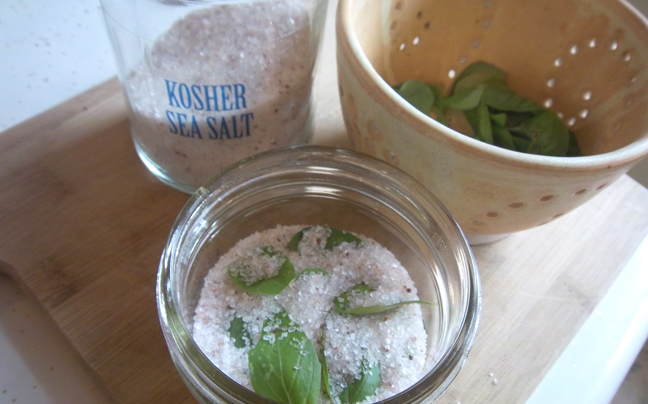
My friend Marsha taught me this method of drying herbs: to immerse them in kosher salt until they are dry, then remove the leaves but don't worry about the small bits left behind. So you get your dried herbs and a seasoned salt as well. I think the reason for using kosher salt is because the iodine added to processed salts can discolor the leaves, but I'm not really sure if that's it. Since I'm using kosher sea salt to dry the last of the basil from my garden, and sea salt retains its naturally occurring iodine, I may find out. But I prefer sea salt because it's prettier than the plain white kind. (Even though I know that it's also supposed to be lower in sodium and higher in other trace minerals and more flavorful than regular white table salt, the real reason I buy it is because it's pretty.)

Last summer, after we bought this house, Marsha brought us a gift of a loaf of bread and some salt she had seasoned with rosemary, and a lovely card in which she had written this note:

"Bread—so you never go hungry, and
salt—so life is always flavorful"

Friday, October 14, 2011

Gathering nectar while they can


The bees and the skippers sure have been loving the lavender this fall.

Thursday, August 25, 2011

Hydrangeas are for butterflies, too

I hadn't really thought of hydrangeas as a butterfly shrub, and I don't recall noticing any butterflies on or around the Annabelle hydrangea that grew at our last house. However, it had only been planted just before we moved in there and it didn't really start blooming in its characteristic profusion until last summer, when we moved out.

Still, I was genuinely surprised when I was going for a bike ride about a week or so ago and spotted a tiger swallowtail happily sipping from a panicle hydrangea in an alleyside garden just a block away. The same shrub played host to a small blue butterfly (like the one I had spotted in my yard only a few days before and wrote about here) and several bees. I really like most hydrangeas, but because I believed that they didn't have much wildlife value, I've tried to temper my enthusiasm for them somewhat, wanting to emphasize wildlife-friendly plants in my garden as much as possible. Now I feel like I've just been given the go-ahead (by a butterfly, no less), to add a hydrangea or two to my landscape plans.

But the one kind of hydrangea I have not so much cared for are the Endless Summer macrophyllas and their mophead kin. They were introduced by Minnesota's own Bailey nurseries several years ago and received with great enthusiasm because they were the first mopheads that can survive our zone 4 winters. I'll admit that my tendency to be suspicious of anything that's too trendy may have somewhat influenced my tepid response to these popular flowers. But it's more than that. Try as I did to appreciate them, I just found them to be a bit too artificial looking for my taste; and I don't like the extra fussiness of tinkering with the soil pH through the use of various additives (most commonly aluminum sulphate) required to get the intense blue color that makes them so popular.

I don't know whether Endless Summer appeals to butterflies, but I do know that the more showy flowers are the ones that are not fertile, so they have no reason to offer nectar to entice pollinators. The kind of hydrangeas that have both the showy flowers and the nonshowy fertile ones (which tend to look like little buds, either clustered in the center, like in the lacecap above, or mixed among the nonfertile blooms, as in the panicle at top), are more likely to offer something for the butterflies. (I admit, I'm speculating here, but it stands to reason, doesn't it?)

I photographed the blue lacecap, above, at a bed and breakfast in Ludington, Michigan, last week when we took a road trip up and around the top of Lake Michigan after bringing our daughter, Nora, to college in Albion. I love the pale blue of the outer florets paired with the deep indigo blue of the small fertile flowers in the center, and was thinking that it would sure be nice if I could grow a hydrangea like that at home. But most of Michigan is in a much milder climate zone than Minneapolis. So, imagine my surprise when I learned that one of the newer introductions in the Endless Summer series, called Twist and Shout, looks just like that!

I'm still considering the different panicle hydrangeas and haven't decided which one I'll plant, or where. But now it looks like I may end up with an Endless Summer hydrangea as well, once I find out whether their soil pH preferences match up with my front yard, where two overgrown fir trees (slated to be removed this winter) have been dropping their needles for a few decades (which may have acidified the soil).


Wednesday, July 20, 2011

A poppy pops up most unexpectedly, and other reports from the late summer garden

I went outside to bring out some trash this morning and was surprised by this sweet little poppy growing amongst the daisies and thistles next to the sidewalk. It's at the edge of the area that is slated to become our kitchen garden, and I am planning a mixed border, including self-sowing annuals, to run along the outside of the as-yet-to-be-installed picket fence, to attract beneficial insects and serve as a cutting garden for bouquets, as well as to simply look pretty. And here's a cheerful reminder to include poppies in that mix!

I have no idea how it got here, of course. I am pretty certain there were no poppies in any part of the garden last year (though it is possible I overlooked them or forgot). At first I thought the seeds may have come from the compost—mine or someone else's—but I don't think it's breadseed poppy (P. somniferum), that's usually taller and most likely a "single" blossom, not a flouncy double like this one. Perhaps it came from someone's wildflower mix, but how it got here remains a mystery. Birds? A squirrel or chipmunk? One of our many nonhuman gardeners of happenstance, surely.

The abundance of rain during this heat wave has certainly taken the edge off, at least for the plants. The lavender seems to be thriving, as you can see here. I envisioned something of a mini hedge of lavender when I planted these four earlier this summer. Even the most hardy lavender is only marginally so in Minnesota, though, so it remains to be seen if it will come back in the spring. It is currently on the west side of the garage, but I am thinking of moving it once I have some of the other gardens prepared. But digging new garden beds is not a project for 90-degree days!

The black-eyed susan and garden phlox are just coming into bloom. They, too, are slated to be moved, probably to the south side of the house. My current "plan" (more like an idea than anything so organized as a plan, really) is to have a wide strip of tall sun-loving perennials, both native and cultivated, all along the south side, except where the faucet and air conditioner are. I need to build up the soil a bit there, to get that gentle slope away from the house, and then plant deep-rooted plants that won't require supplemental watering most of the time, but will seek the moisture way below the surface. I'm envisioning something of a cottage/prairie garden hybrid, with some of those taller prairie forbs and grasses to the back, and the not-quite-so-tall cultivated perennials in front of them. Or something like that. That's a September project, though, when it's safe to move the peonies, which are the only plants (other than weeds) growing there now.

It definitely helps to be in no big hurry to get these various gardens installed, because my ideas have evolved over the past year as I've observed what's going on all around the property, where the sun shines most, where the rain water tends to puddle, and so on.

Wednesday, June 8, 2011

Rescuing the Peonies

Last June, before we actually closed on our purchase of this house, I stopped by with a handful of Popsicle sticks and a Sharpie to label the peonies along the south side of the then-empty house, noting  the color of their blossoms. I reasoned that by the time we moved in, their petals would have long since dropped and withered and I wouldn't know which were pink and which were white, and I thought I might want to dig them up and move them in the fall, with an eye to some to-be-determined color schematic.

But our house offered plenty of projects to keep us busy and I didn't get to the garden at all last summer. That's just as well, because it allowed me a full growing season to observe and photograph the garden. Among the things I observed was that nearly all the peonies were afflicted with splotches on the leaves and spots on the stems, most likely caused by one of several fungal diseases of peonies, especially if their spent stems and leaves are left to rot in place over winter. It also looked like some of the buds had failed to open at all.

Not remembering the blossoms themselves as anything special, only that some were white and some were a medium pink, I had pretty much decided they weren't going to be worth the bother and that I would just discard and destroy the plants and start over, planting new ones in a different location to avoid infecting them with the same problems.

Bloom of, possibly, Peony Annisquam
Then they bloomed, and I was smitten. As I hope you can see from the photos, the "white" ones are really a very pale pink, and their blossoms are so full of petals that even after dozens of the petals fell to the floor when I was rearranging them for the picture, they're still large and voluptuous flowers. And of course they smell wonderful, as do all peonies. A Google image search has me thinking these are probably Peony Annisquam, a 1951 introduction, and available from a Minnesota nursery, Hidden Springs Flower Farm. Since Julia Johnson had tended this garden from the 1950s on, and, from what I have learned from her children (who sold us the house) and our neighbors, was a pretty sophisticated gardener, it's likely she would have bought a few stylish new plants to enhance her yard. At today's prices, the several specimens that grow alongside the house would cost me $25 each to replace. I think I'll keep them.

Even the "ordinary" medium pink ones are, of course, beautiful and fragrant. How could I have thought I could so cavalierly discard them? Besides, ridding peonies of a disease such as this is pretty straightforward and amounts to nothing more than a few good cultural practices: adequate sun and water, good drainage, good air circulation, and—especially important in this case—a thorough cleanup of all plant debris in the fall.

Note the spots on the stem and browned edges of petals
Since I want to move them anyway, preferring a good swath of prairie next to the house (the reasons for which will be the subject of another post), I'll do so in September, a good month for dividing and planting peonies. When I do, I'll rinse the roots to remove the soil, which likely carries the spores of whatever is infecting them, and plant them in fresh soil amended with compost and manure. And as soon as the first frost zaps them, I'll cut all stems off at the soil surface and discard them and all the leaves (or, more likely, bury them at the bottom of a hugelkultur bed). I have treated similar peony problems this way before and did not have to do anything more, except to continue to remove the plant debris after frost.

Peonies are extremely long-lived perrennials, and I'm looking forward to many years (decades, really) of these luxurious flowers. It's also sweet to imagine that long after I'm gone, those peonies will still be here to delight future occupants of this house.