Monday, July 8, 2013

What were they thinking?

The previous owners of our house, Harry and Julia, had a thing for placing bricks in the ground.

Not those solid landscaping bricks that can make very charming edging, patios, and pathways -- regular building bricks with holes in them.


Nor did they submerge them on their sides to hide the holes; they placed them so that the holes were facing up.

So, naturally, plants planted themselves in the holes. Like grass, weeds, and these ferns.


Along the north side of the garage, which is one of the first areas that we completely relandscaped, they not only placed dozens of these bricks, but then they planted hostas all in a row alongside the bricks, which, when placed on top of the ground with their holes exposed, make really excellent slug habitat. The bricks were not only full of slugs, but you can probably imagine what the hostas looked like.

I can't help but wonder, what were they thinking?


We've been repurposing the bricks in various ways, such as defining the edge between the rain garden and a perennial border. Even though the holes are partially exposed here, we haven't had any slugs move in, probably because there are no hostas to feast on, and the slimy little critters would have to crawl across the open rocks to get to the holes, and we have a whole family of hungry robins hanging out, just waiting for them to do that.


Lately I've been digging out a row of ferns on the north side of the house and replanting them in a shady garden bed in the front, where they should form a pretty backdrop and obscure the plain gray concrete foundation blocks.

But sometimes the ferns and the bricks are hopelessly entangled, and there's no solution but to slice off the ferns and toss them in the compost.


In other instances, the bricks are already cracked and easily split apart, leaving an ogee-like impression of root mass.


We're reusing the bricks in various places around the yard, laying them in the ground sideways on a base of sand, with the holes (mostly) submerged, in combination with salvaged patio blocks and chunks of concrete. And when we run out of found bricks, I will probably go out and buy some more in order to edge more of the gardens with them, because I have a thing for bricks, too.

But I'm going to get the kind without holes.


Sunday, June 30, 2013

Because We Just Gotta Have an Afternoon Patio and a Morning Patio

This is the corner of our backyard that used to be Julia's garden, but which was a mess of weeds, raspberries and flowers by the time we bought the house. Little by little, I've been moving the various flowers to different parts of the yard, and some of the raspberries to the kitchen garden near the alley, then digging out the weeds.

That corner also had a small patio, which our neighbors have told us was where Julia's husband, Harry, used to like to sit. Apparently Julia didn't really use it after Harry died. That patio was too small and too sunny in the afternoon for us, so we took those blocks, plus some other materials salvaged from elsewhere in the yard, to make a patio on the east side of the house, which gets shade by three in the afternoon.

But that patio is too bright and sometimes too hot in the morning, when it would be lovely to take tea and the newspaper outside, so we decided we needed a second, morning patio, and realized that the best spot for that was on the west side of the garage—Harry's old patio spot. We figured that a second patio would also allow space for a fire bowl, which doesn't really fit on the first patio because we have a dining table and chairs there. The whole backyard is shady by about 6:30 in the evening, so either spot is pleasant in the evening.

But since it's Sunday and we both want to have a leisurely breakfast and read the paper for a bit before beginning any ambitious projects, by the time we started working on this shady-in-the-morning patio, it was in full sun.

So this is how my husband relaxes on his day off.

After leveling the soil and spreading 15 bags of sand, Craig placed a big honkin' heavy square hunk of cement, which had been sitting by the alley, at a strategic point, which will be where the fire bowl sits.

Then I say, Hey, how about edging that with some bricks? Because I'm full of good ideas like that.


The bricks are a mismatch of some we found here and there in the yard and a few our neighbor was discarding, including this one stamped Purington Paver, which looks kinda like an artifact to me, so I make sure to place it so the inscription will show. (The little square gap will be filled with pebbles or a small plant, I haven't decided yet.)


Over the past couple of weeks, Craig has carted about three dozen or so rectangular patio blocks from the house of a friend who didn't want them anymore; we also collected a few discarded blocks from our neighbor. So we started arranging them in a sort of herringbone pattern. (Yes: "we"; I did help, I'm just not in any of the pictures because I was taking them.) Then, at this point, I say, I think it all needs to be moved about a foot or so to the left. Because I'm helpful that way.


It's just that we needed a little more space between the fire bowl and the chairs; and it did soon occur to us that we could just move the big square far enough over to insert another row of the rectangles, rather than move all of them.

It's about four in the afternoon when Craig puts the finishing touches on the new patio, and sits down to take a little break.


But as it's still sunny there, he soon came over to the "old" patio (constructed two years ago) to join me in the shade. Tomorrow morning he'll head off to work and I'll be in charge of trying out the "morning" patio. It's another way in which I'm helpful.


Tuesday, June 25, 2013

Wrenifications


The wren first appeared in our backyard a couple of weeks ago, announcing his presence with what the Cornell Lab of Ornithology describes as a “rush-and-jumble song.” I was delighted to see him checking out the small bird house near the patio, then became alarmed when he headed over to the slightly larger one by the kitchen garden, because I thought the chickadees were still using it.

Wrens are known to be real estate hogs, stuffing many houses with twigs to form “dummy nests” so that other birds can’t use them; they sometimes go even further than that and actively eliminate the competiton. According to Cornell, wrens are sometimes the main reason for nest failure of bluebirds and chickadees, as well as some other species, which is why many birders don’t like them. So I was worried that the little fellow was going to do harm to the chickadee chicks.

I scurried over to shoo him away, saying, “You get away from there! That’s the chickadee house! You use the other house!”

“You’re talking to a bird,” said my husband from his seat on the patio.

The wren scuttled onto a perch in our neighbor Sue’s lilac bush, and I noticed that she had a bird house next to her garage also. Aha!  No wonder our yard is a magnet for the little speculator.

I didn’t hear any peeps coming from the chickadee house, so I decided to inspect it to see if the chicks were okay (a well-designed bird house will be easy to open so you can keep an eye on its inhabitants). What I found was a clearly abandoned nest. I then remembered seeing chickadees in the lilacs about a week ago, fluttering their wings like fledglings, but as they looked identical to the adults (not scruffy like robins) and I did not see them on the ground, I hadn’t put two and two together.

So I apologized to the wren, and he was soon happily stuffing twigs into both of our bird houses and, I suspect, Sue’s as well.

“In spring, the male establishes a small breeding territory by singing from exposed perches and putting stick foundations in prospective nest holes,” wrote Donald and Lillian Stokes in their Field Guide to Birds.

After several days of this, there was suddenly a noticeable absense of the wren’s musical bravado in the morning. Had his mate selected some other house down the block? If so, I was indeed sorry. They may be bad birds, but they’re voracious insectivores, and as a gardener first and bird watcher by extension, I would dearly love to have a family of wrens on pest patrol in my garden.

Then one morning I heard not only his by-now familiar burbling call, but a whole lot of chittering. I looked out the window to see two wrens engaged in a lively discussion as one perched on a nearby branch while the other went in and out of each of the houses.

It was fun to see this “songful tour of inspection,” as described by Christopher Leahy in The Birdwatcher’s Companion, after which the female chooses a nest and finishes it. And she’s a clever bird in setting up housekeeping, for she is known to stash a few spider egg sacs in the nest so that the spiders will devour any parasites that may infest the chicks, say the folks at Cornell.

I’m having a hard time telling which house she chose, as they appear to be dallying about both houses still. They are very active little birds, and the sexes look alike, so I find myself wondering if there is, indeed, only one female. According to Leahy, the name wren, which comes from the Anglo Saxons, has a traditional second meaning of one who is lascivious, possibly because of the polygamy of male wrens.

Tuesday, June 18, 2013

A June Evening in the Garden

A late June evening and the solstice less than a week away and surely these are the very best days of summer, especially the very best long, lingering evenings. Finally there is enough shade on my east-facing backyard to capture the subtle details of the Henry Hudson rose; I know I've posted photos of this one already, but the yellow stamen at the center always seem to get lost in the bright light of day, so here is a better view of it by the evening light.


So far it is looking exquisitely healthy, and it is a disease-resistant rose, but I think it is later in the summer that the toll of excessive rain and whatever critters the wind blows in will be the test of that. Having it so near the patio encourages me to check it regularly for signs of problems. So far, so good. I did bury a bit of alfalfa meal and organic fertilizer in its planting hole last summer when I brought it home, and I bought it from a nursery that doesn't use pesticides (Sam Kedem's in Hastings), so it got off to a good start at least. I also planted it in a open airy spot with morning sun, all necessities for roses so that the dew and rain will dry off their leaves quickly and reduce the risk of mildew.

Meanwhile, the other rose, a very tough and vigorous and downright exuberant specimen, Rosa glauca, is going to town and loving its breezy spot with lots of sun. I think I need to get a tuteur for it, though, it's a bit all over the place. I bought it in the fall of 2011, and it is arching over the garden fence and reaching for the top of the clothes pole already. Here I'm only showing you a glimpse of one branch coming in from the right because it's hard to capture its charms and give a sense of its true size all at once. The individual flowers are small (about 1.5 inches across), single and pink. The leaves have a bluish cast to them (hence the species name, "glauca"). I chose it both for its aesthetic charms and wildlife value. It gets showy red-orange hips in fall, and the birds and butterflies are supposed to like it.


To the left above is a "blue muffin" viburnum. It will get clusters of blue berries that the birds can eat later in the summer, and the leaves turn a nice burgundy color in fall. The kitschy birdbath is one I salvaged from an alley not far from me.


My other backyard birdbath is a large one near the patio, just outside the window of my home office, and I'll often hear splashing sounds, then look out the window to see a robin enjoying a bath. I surrounded it with lady's mantle because the fuzzy leaves hold onto droplets of water like shiny beads.

It sits under the crabapple tree, which is an attractive staging spot for birds before imbibing, like this gold finch that paid a visit as I was sitting on the patio this evening.


The gold finches don't hop into the water like the robins do, perhaps because it's a bit deep for them, but this bright little fellow will lean down to get a drink of water, after a good deal of cheerful tweeting to let us know he's coming in for a landing. Unfortunately, my camera wanted to focus on some weeds in the background, so you just get an impression of his wonderful color as he paused briefly, took a sip, and then flitted away before I could try for a second photo.


Sunday, June 16, 2013

Another Harvest of Little Blue Flowers, as Henry Hudson Looks On

I'm happy to announce that summer has finally arrived in Minneapolis. A friend recently posted on Facebook an overheard comment that pretty much sums it up for all of us: "Looks like summer finally got the memo."

Although the patio, on the east side of the house, is a little too sunny in the morning, there is a little period from about 9:30 to 10 or so when the huge maple tree across the alley casts a bit of dappled shade just where we need it, so we took our tea and the Sunday paper out to sit on the patio for a bit.


The Henry Hudson rose that we planted next to the patio last summer seems quite happy with its morning sun, though.

Once the patio was back in full sun again, we took advantage of the brief morning shade in one of the sunniest parts of our yard, just west of the garage, to do a little digging and transplanting. It's the previous owner's former perennial garden, which had become a raspberry thicket by the time we bought the house, so we've been having at it from time to time, replanting some of the raspberries to a different spot and discovering what else has been growing there under the thorny canes, besides dandelions and tall lawn grasses, that is.

Among the gems hidden amongst the raspberries was this dictamnus (aka gas plant) that I transplanted a couple of weeks ago. As you can see, it has taken happily to its new home.

Craig digs, I transplant. We have to do this side by side because Craig will go at the job with abandon if I'm not there to say, "Stop! Those are daffodils! And those are grape hyacinths!" (To be fair, the strappy leaves do look a lot like grass by this time.) So, dig and replant was the theme of the morning. I've been trying to do most of my transplanting during the week when he's at work, but last week I was too busy with other things and he was anxious to get on with the job of clearing this area out so we can replant it in some sort of orderly fashion.

There are some pretty blue flowers that I forget the name of (I figured it out last summer, but I'm not sure where I wrote it down; some sort of verbena or vervain, I think). I transplanted a few clumps, but much of it is overgrown, falling open at the center, and the lower leaves are looking spotted and unhealthy, so I am only transplanting the separate stands here and there that are smaller and healthier. However, I hate to throw the pretty blue flowers in the compost, so I harvested nearly all the stems from the big clump and brought them inside for a bouquet.


I also hated to toss the confetti of little flowers that fell on the counter top while I was trimming the stems, so I gathered them into a small bowl and placed it on the table to be ready to catch some of the others that fall. It's not the best florists' flower, for all of its flower-shedding tendencies, but I sure like that riot of little blue blossoms.


Tuesday, June 4, 2013

Transplanting and bouquet gathering

One portion of the fernleaf peony in its new home.
The rules for digging up and transplanting or dividing perennials are pretty simple: do it when they are first emerging, unless they normally flower early in the season, and then it's best to wait until late summer, long after they're done flowering. Or something like that.

But what if it's raining every day and you are still dealing with a big messy weedy patch where a garden used to be, and you really want to transplant all the good stuff as early in the summer as you can so you can clear the rest of it out and get on with doing something else with that corner of your landscape?

Well, then you just muddle along as best you can.

I once asked a Master Gardener if I could get away with transplanting a perennial in the middle of summer, during hot weather. She said, "Yes, if it doesn't realize you're moving it." Gardeners often speak of plants as if they were sentient beings, so I had no trouble understanding what she meant: dig it up in one big clump without disturbing the roots.

This is more easily done with some plants than with others. So when I tried to dig up the fernleaf peony (Paeonia tenuifolia), even as it had flower buds forming, I was dismayed when the roots fell apart as I attempted to lift it from the ground. It was an old peony and was due to be divided anyway, but late May is not the time to divide peonies!

So I performed a little triage, removing all the stems that had flower buds on them and bringing them indoors to put them in a vase, then transplanting about half the plant. I'll transplant the other half too, once I decide where I want to put it. I'm sure I won't see any more flowers on this plant this year, but it will have plenty of time to adjust to its new home and should bloom happily next spring.

The newly transplanted dictamnus, next to a successfully relocated lily.
The other plant on the verge of flowering that I dug up, with more success, was the dictamnus, or gas plant (Dictamnus albus). After the experience with the peony, I tried a different approach. First I sharpened my spade with a file, then I shoved the spade into the ground all around the plant before attempting to lift it, and as a result I got a pretty intact root clump, dirt and all. It helps that the ground has plenty of moisture in it from all the rain we've been getting.

I was careful to plant it at exactly the same depth as before, but with a hole that was a bit wider than the root ball, then filling in around it with little or no disturbance to the roots. Still, there were a few stray stems, so I cut those off and brought them in to add to the bouquet. I also moved a lily, but that won't bloom until late July or August, so it isn't showing any sign of forming buds yet.

Finally, I took some flowers from the mountain bluet (Centaurea montana), because I plan to move that one soon as well. And a little blue in the bouquet seemed like just the right complement for those dark red buds from the other two flowers.

It remains to be seen if the dictamnus will proceed to blossom as normal. If the flowers show no sign of opening after a reasonable period of time, I will have to cut it all back a bit so the failed buds don't deplete the plant's energy.

My bouquet of mostly closed flower buds is not particularly showy, but I enjoy the understated mix of foliage dotted with blossoms (that is one of the perks of having a fernleaf peony -- the great foliage). And I'm a couple of steps closer to taming the backyard, which is actually worth the sacrifice of a few flowers here and there. Like a good bouquet, a pleasing landscape is more about the composition than about the individual elements contained within it.

Friday, May 3, 2013

A Walk Below the Falls on a Spring Morning

It was just a few days ago that the nights here were so balmy that we left the windows open all night for the first time this year. I awoke early Tuesday morning, feeling the humidity in the air, hearing the birds, sensing the sunlight peaking under the partially raised shade of our east window. When it became clear to me that I wasn't going back to sleep, I decided to get up. It was about 6:30.

Up early on a spring morning, I decided to go for a walk. (And not knowing that soon the wintry chill would return yet again—I awoke this morning to see snow on the green grass. Yes, on May 3rd.)


We live just a half mile from Minnehaha Falls, so I walked down to admire the waterfall's abundance fed by the melt down of all the snow we got in April (more than in January!). 


I descended the many stone steps to the creek below the falls, which leads to the Mississippi River.

Spring is getting a late start around here this year, so there's not much color yet other than the stems of the red-twigged dogwood (seen on the left above).


But as I continued along the path and then the boardwalk, I saw a welcome smattering of green. Much of the ground surrounding the creek here is marshlike, and so there is a boardwalk to allow visitors to keep their feet dry and not disturb the soft soil, where bog plants like this skunk cabbage thrive.


I don't recall ever seeing skunk cabbage in bloom, so this siting was a real treat.


This stand of bloodroot in bloom was also a pleasant surprise.


I was alone for most of the time, except for the songbirds and this small hawk; we have two species of small hawks here in the city, Cooper's and sharp shinned, but I didn't see this one well enough to tell which it was. It was keeping a good watch on me, though. 


When I reached the end of the boardwalk, the trail up ahead was muddy and rutted, so I decided it was time to head back home. I did cross paths on my way back with a young couple out for a morning stroll, he with a cup of coffee in hand. Other than those two and me, there was nobody down by the lower creek on this warm spring morning, and no sound other than the creek and the birds.

I walked home from the park a couple of blocks on city sidewalks, waiting for a gap in the morning traffic before crossing 46th Street, up another half block, and in through my front door to make breakfast and tea. I'd been gone an hour but had only walked a couple of miles in that time. Yet it seemed as though I had been so much farther away.


Tuesday, April 23, 2013

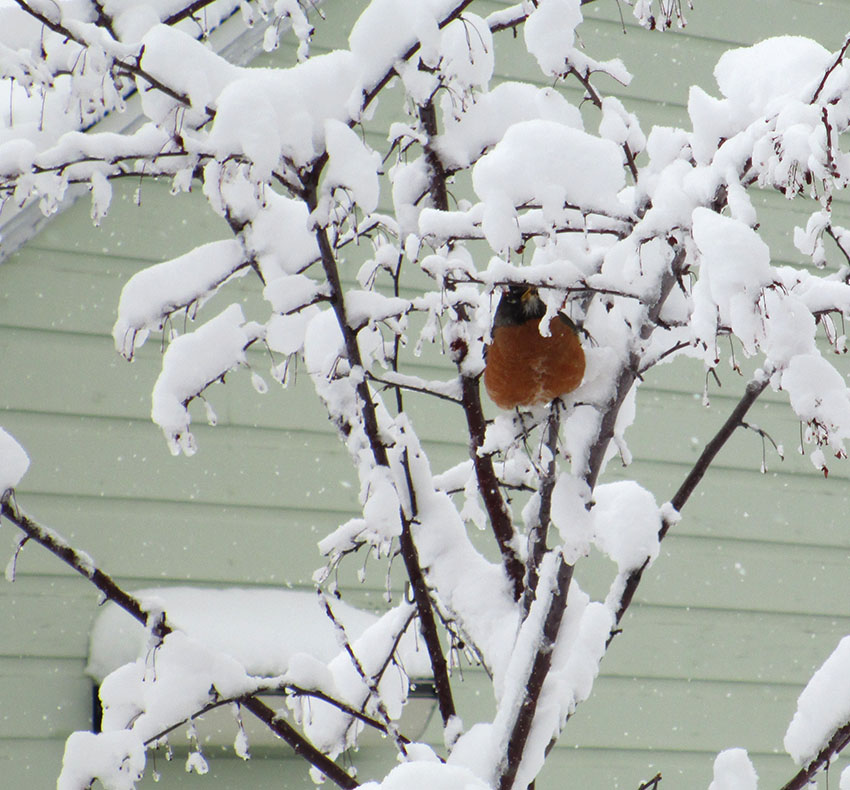
Snow — just another spring ephemeral


A note: I wrote this for the March 8, 2004, edition of the late Minneapolis Observer, a short-lived newspaper that my husband and I used to publish. It's topicality is apropos this spring, while at the same time revealing how unusual it is even here in Minnesota to get this much snow this late in the season. Still, it's a reminder: it's all ephemeral, nonetheless. —Sharon

On Thursday, my friend Sandra was positively gleeful at the prospect of 6 inches or more of snow. She is an avid winter athlete and once cross-country skied on Theodore Wirth golf course after a particularly late April snowfall, much to the chagrin of the groundskeepers.

By March, my attitude toward winter is one of indifference. After 47 winters, I am no longer impatient for spring to begin—I know it will come soon enough. And I am no longer dismayed by late-season snowfalls, even after a long thaw has dangled the promise of an early spring only to snatch it away again. I know it won’t last.

I think of this snow as the first of the spring ephemerals. In gardening, we usually think of ephemerals as those early bloomers that disappear, leaves and all, once summer is underway: the bulbs we plant in fall; the woodland wildflowers that bloom before the trees leaf out, then retreat under the ground again.

But snow is one of these too. Consider how profoundly it transforms the landscape in winter—the mounds that turn our sidewalks into valleys, the mountains in the corners of parking lots, the bright white clingy coat that forces the arborvitae to bow down in homage to the forces of nature, the snow “flowers” on mugho pines. And then it all melts away. Vanishes. A re-creation of the great ice age, in mere months, and then nothing. I know I’m odd, but the whole transformation from winter’s snow-sculpted landscape to flat, muddy early spring—even before the greening of spring at its peak—fascinates me. Every year.

So as I went about my business on Friday while clumps of wet snow dropped heavily from the trees as frequently as the big sticky flakes fell from the sky, I was glad I didn’t have to look at the dirty grey-black patches of ice that had been everywhere and will be exposed again soon. We can put off cleaning the yard a little longer. I just discovered one of my boots has a leak but my wet foot doesn’t make me miserable because I’m distracted by the unfolding drama. I look around and marvel at a fleeting winter wonderland that soon will be no more.

Friday, April 12, 2013

Making your own polish for wood and other things

One of the toy sets from Arty Didact

The little tins of "stuff" that I assemble as quirky amusements for kids usually include a few wooden objects, as do my "respite boxes" for adults.

In order to give these wooden components a nice luster and to  provide a pleasant tactile experience, I have taken to rubbing them with a beeswax-and-oil polish. It's a simple homemade concoction that's quite versatile—you can use it on stones and on your skin, as well—and it's a good way to reuse beeswax candle stumps and bits of beeswax cakes that have become too dry and brittle to use on thread anymore.

I thought I'd share it here for others who, like me, derive some satisfaction from finding a practical reuse for something that would otherwise be discarded.

Expecting to find that the process of making one's own polish is somewhat complicated, I was pleased to come across Amber Dusick's charming blog, where she offered her simple recipe using only two ingredients: oil and beeswax. My adaptation is to use scrap beeswax and whatever oil I have on hand at the time. The first time I made it I used grape seed oil, which resulted in a very green polish. My current batch is made with olive oil, which did not alter the color of the beeswax in any noticeable way. Neither polish changed the color of the wood I rubbed it on, other than to darken it, so I don't think it really matters what oil you use.

As a frequenter of estate sales, I found a nifty little metal pitcher with a long handle, which seems to be made for just this sort of thing. I put my beeswax bits in it and added olive oil, attempting for a ratio of 2–3 parts oil to one part beeswax; but as I don't actually measure anything, I don't know whether that's quite what I've got here. That's a lot less oil than Amber's ratio, which is 4 parts oil to 1 part beeswax, and I do end up with a rather stiff polish. I'll probably try getting closer to her proportions next time, for a softer polish.

I also don't bother to grate the beeswax as she does, I just break or chop it into chunks. For the small amount of polish that I make at one time (about a half cup), that seems to work just fine. I place the metal pitcher in a pan of water on the stove and let it simmer until all the wax has melted.


Since the wax has bits of thread in it—and if I were using leftover bits of candles, there would be a wick and that little metal thingy that's in tea lights—I pour it through a tea strainer into a small canning jar.

A little thread lint captured by the tea strainer
Then you just let it sit until it cools and sets. The outside will set first, of course, which will insulate the center and keep it from cooling as quickly. 


You could go have a cup of tea and read the paper while you wait for the rest of it to cool, I suppose. 


Or, if you're impatient like me, you can stir it to speed the setting process. 


Here are a few wooden cubes, half rubbed with the polish and half not. See how it brings out the wood grain and generally prettifies them nicely?


Oops. Better put the cubes away before they disappear under the furniture.

Monday, April 1, 2013

Who Said What: Why I Don't Repeat Quotations Found Online

Today my local newspaper reprinted an article from the Columbia News Service about the common practice of finding and repeating false quotations on the Internet. The article by Jennifer Hollander leads with the example of a quote I saw often on Facebook after the assassination of Osama bin Laden, which was falsely attributed to Martin Luther King Jr.: "I mourn the loss of thousands of previous lives, but I will not rejoice in the death of one. Not even an enemy."

In  fact, writes Hollander, it was the Facebook status of an American living in Japan, who followed her eloquent statement with a quote from King. A friend reposted it, dropping the quote marks, after which it went viral, with the false attribution.

The article reminded me of a little project I undertook a couple of years ago, to make a little booklet of quotations from children's books that offered humorous "good advice for all occasions."

The project started with a quote I remembered from a book I had read to our children more than once, Talking to Dragons, by Patricia Wrede, the last book in her Enchanted Forest series. The lead character, Princess Cimorene, had, in the very first book in the series, run away from the pampered and boring life of a princess (as she saw it) and gone off to seek adventure or at least intellectual stimulation in the company of dragons, which turned out to be rather erudite creatures.

In the last book, Cimorene was sending her son, Daystar, off on adventures of his own, and her parting words to him included the simple advice, "Always be polite to dragons."

Alice illustrates a quote from the Red Queen. 
I filled the six-page mini book with a few other favorites I remembered from reading various books to the kids when they were little, and which I could easily check because we hadn't gotten rid of any of the books, even though both kids are now in their twenties. But I needed one more quote and so turned to the Internet to find it.

There I came across a charming quotation attributed variously to Kenneth Graham or more specifically his book Wind in the Willows: "Come along inside ... We'll see if tea and buns can make the world a better place."

Such a sweet sentiment. So I did a drawing of tea and buns to go with it. Then I realized that I needed a more specific attribution for the quote—which character said it and to whom? So I took out my copy of Wind in the Willows and started perusing. I couldn't find it. Maybe I skimmed right past it, I thought. I found an online searchable copy of the book and looked for it there. Nothing.

I found an online source of other works by Kenneth Graham, yet still could not find the quote.

In the end, I gave up. Not knowing the true source of the quote (it may still have been said/written by Kenneth Graham, but in what I do not know), I decided to use a different quote. But I already had my drawing of tea and buns, and I wanted to use it, so I remembered that Buddhist monk Thich Nhat Hahn had said something about drinking tea mindfully, and I set out to find that one to use instead. On the Internet I found several slight variations; fortunately, we have several of his books, and I guessed correctly that it must surely be in The Miracle of Mindfulness, which it was.


"Drink your tea slowly and reverently, as if it is the axis on which the whole world revolves—slowly, evenly, without rushing toward the future." —Thich Nhat Hanh

And that's how my little booklet of quotations from children's stories ended up with one quotation from a book for adults about living our lives with intention. (And why I illustrated a Buddhist quote with a drawing of a very English-looking cup of milky tea and brioche buns.)

Monday, March 18, 2013

What?! More snow?! No! We want flowers in the house!


Here's today's forecast for Minneapolis, courtesy the National Weather Service:

"Snow likely before 1pm, then a chance of light snow between 1pm and 2pm, then snow with patchy blowing snow after 2pm."

Can you use "snow" four times in one sentence? That's on top of the 7 or 8 inches already sitting on the ground. You might notice how white it looks through those windows.

Ah, but I see from visiting Jane's flower party, that I'm not the only one with shoveling rather than gardening on my day's agenda. Actually, I expect gardening won't be one of my tasks for several more weeks, but that's pretty standard around here. All the more reason for flowers in the house.

If you're new to flowers in the house, you really must click the link on "flower party" above and have a look at all the lovely blogs featuring flowers today, thanks to Flower Jane and her Small but Charming blog. Thank you, Jane, for continuing this cheerful monthly tradition. Come to think of it, I have nothing to complain about.

And, fortunately, somebody knows how to grow flowers at this time of year around here, because when I went to the co-op, I was pleased to not only find a rather decent selection of flowers, but a sign indicating that they are locally grown. (Well, not outdoors, obviously.) So I selected some cheery orange tulips and a bundle labeled "filler." I chose a filler bouquet with a bit of violet purple in it to complement the orange.

I feel better already.

And it looks like the big meltdown begins on the weekend, with temps in the high 30s.

Cheers!


Tres on a balmy day last summer
And as you can see, I'm not the only one dreaming of spring! (Did someone invite cats to the party? Oh, yeah; they invite themselves.)